

How to Create Consistent AI Characters Across Multiple Images becomes difficult as soon as you need more than one successful frame. For campaigns and training, consistent characters across multiple images can shift face, hairstyle, age, clothing fit, or body proportion between generations. That drift breaks continuity. The real task is not generating a good character. It is controlling what must remain unchanged while everything else moves.
Why Consistent Characters Across Multiple Images Drift
Image models do not treat a written character description as a fixed identity record. A prompt such as “professional woman, dark bob haircut, navy blazer” describes a category, not one exact person. Each generation can satisfy the words with a different face, jawline, eye shape, hair length, or build. The prompt may feel specific to you while still leaving the model a wide visual search space. Consistency improves when you stop relying on description alone to carry identity.
Drift also increases when too many variables change at once. You ask for a new pose, a new camera angle, a different outfit, a different expression, and a new setting in the same step. The model has to reconstruct the entire scene while preserving a person it does not truly store as a persistent character. Small deviations compound quickly. By the third or fourth image, the series may resemble a casting call rather than one person moving through several scenes.
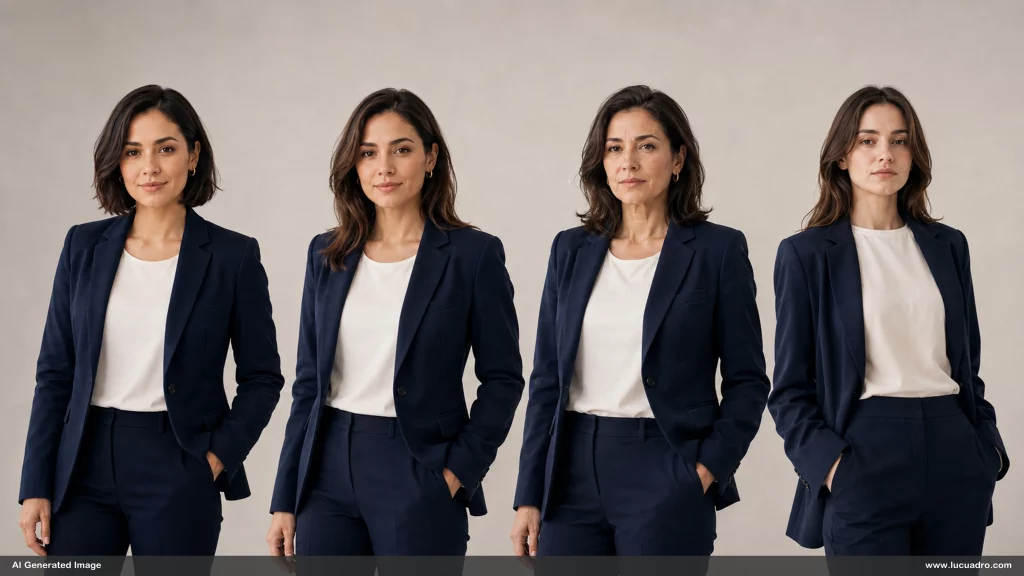
Reference Images Give AI Character Prompts a Stable Identity Anchor
A strong reference image narrows the identity problem. Instead of asking the model to recreate a person from adjectives, you give it a visual anchor containing facial geometry, hairstyle, proportions, wardrobe cues, and overall presence at once. That does not guarantee perfect consistency, but it reduces ambiguity far more effectively than adding another paragraph of descriptive prompt language. The reference should be clear, front-readable, well lit, and free from distracting accessories that you do not want repeated accidentally.
Choose the reference before you start building the larger set. Treat it as the master character image rather than one result among many. If you later decide that the face, haircut, or clothing identity is wrong, replace the master and regenerate from the new source instead of mixing old and new references. This gives your AI character prompts for business and marketing visuals a stable origin.
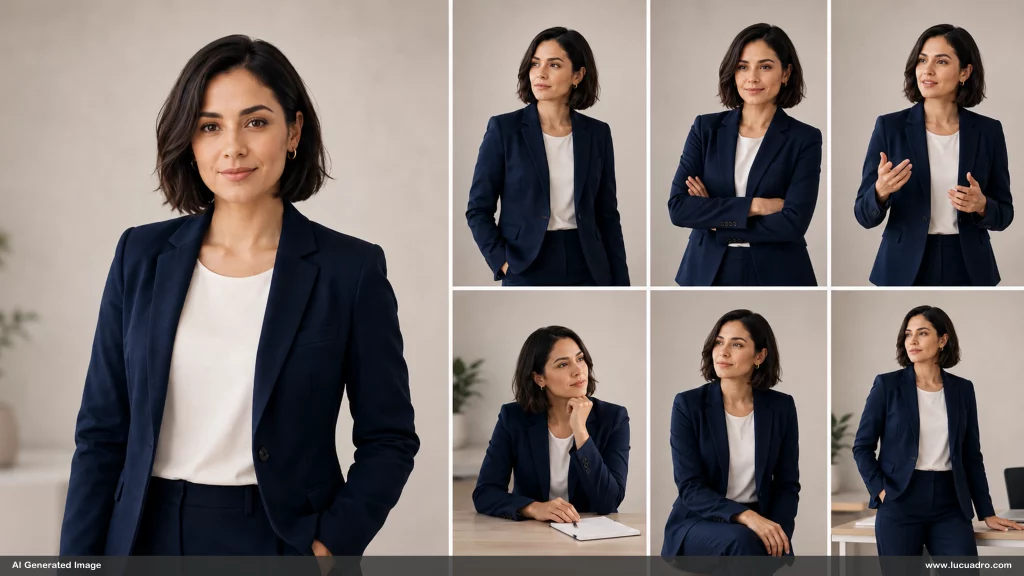
Lock Identity Traits Before You Change Pose, Expression, or Scene
Separate character traits into two groups: invariants and variables. Invariants are the features that tell the viewer this is the same person, such as face structure, hair, approximate age, body proportions, signature clothing, and a small number of defining details. Variables are what the character can do without becoming someone else: pose, hand position, expression, camera distance, background, props, and task. The more clearly you make that distinction, the easier it becomes to diagnose why a generation feels wrong.
Change variables in controlled steps. First create the same character in a few simple poses against a neutral background. Then test expressions. Then test wider framing, alternate angles, or task-specific props. Only after the identity survives those changes should you place the character into more complicated scenes. This sequence gives you checkpoints. If the face changes when the camera turns three quarters, you can fix that problem before adding a meeting room, presentation screen, phone, and five other visual demands.
Clothing deserves special attention because it can act as part of the identity system. A campaign character who appears in a recognizable jacket, shirt, uniform, or color combination is easier to read as continuous even when the pose changes. That does not mean every image needs identical styling. It means you should decide what is essential before introducing variation. A consistent character set works because the viewer receives enough repeated cues to recognize the person without having to inspect the image closely.
Build a Consistent Character Set Before You Build the Campaign
The most reliable workflow produces a small character library before producing finished campaign scenes. Start with a neutral master image, then create a compact set of reusable poses and expressions while keeping the visual conditions simple. A useful base might include standing neutral, presenting, pointing, holding an object, listening, smiling, concerned, and thinking. The goal is not maximum variety. It is to prove that the identity survives controlled variation and to create source material you can reuse when the final compositions become more complex.
Once the base set is stable, build scenes from those approved character versions instead of asking the model to reinvent the person for every composition. A safety training deck may need the same instructor beside equipment, speaking to a group, and demonstrating a procedure. A recruitment campaign may need the same employee on a landing page, social post, and internal banner. Working from approved character assets gives each composition a stronger starting point and reduces the amount of identity reconstruction required.

This also changes how you judge outputs. Do not evaluate each image only as an attractive standalone result. Compare it against the master and the rest of the set. Check facial structure, hairline, body scale, wardrobe details, lighting logic, and the small features that make the character recognizable. Reject visually impressive frames that break continuity. For recurring content, consistency has more practical value than one unusually polished image that cannot belong to the same sequence.
How to Create Consistent AI Characters Across Multiple Images is ultimately a control problem. You get stronger results when identity is fixed first, variation is introduced deliberately, and approved character assets become the basis for finished compositions. A Lucuadro visual asset library approach follows the same production logic: preserve reusable visual building blocks, then recombine them without surrendering control. That shift turns isolated AI generations into a character system you can actually use across repeated work.