
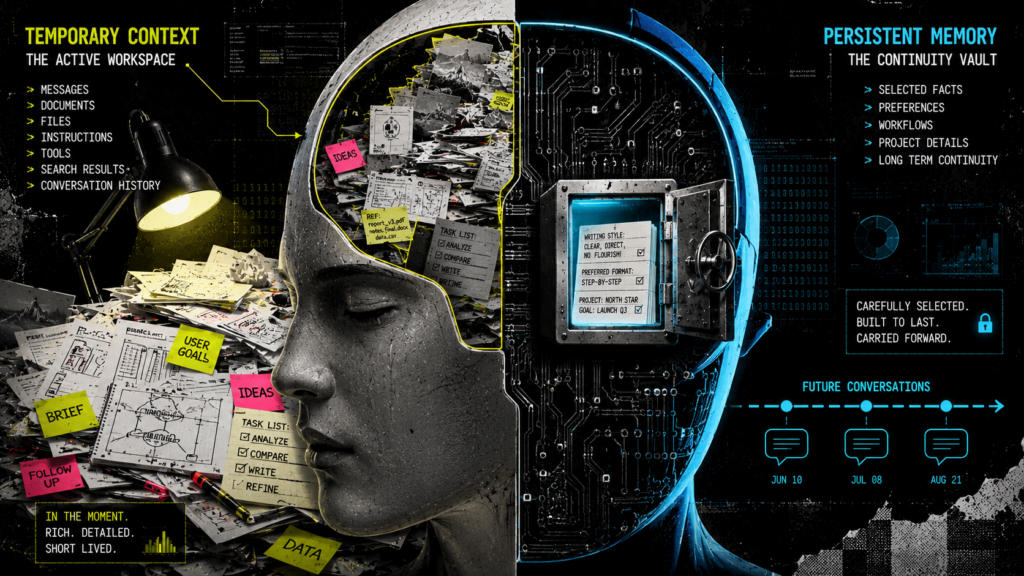
Temporary context vs. persistent memory becomes much easier to understand once you separate what an AI can see during a conversation from what it can retain for future conversations. Temporary context is the working material available right now. Persistent memory is information saved beyond the current interaction. They can feel similar because both influence responses, but they differ in duration, purpose, visibility, and how reliably they should be treated.
Temporary context is the AI’s current working view
During a conversation, the model receives a body of information that may include your recent messages, uploaded material, system instructions, and tool results. That collection is temporary context. It gives the model the information needed to respond coherently right now.
You can think of it as the material laid out on a desk during a task. The model can use what is present, connect ideas across the conversation, and refer back to earlier details while they remain available.

Context can disappear without being forgotten in a human sense
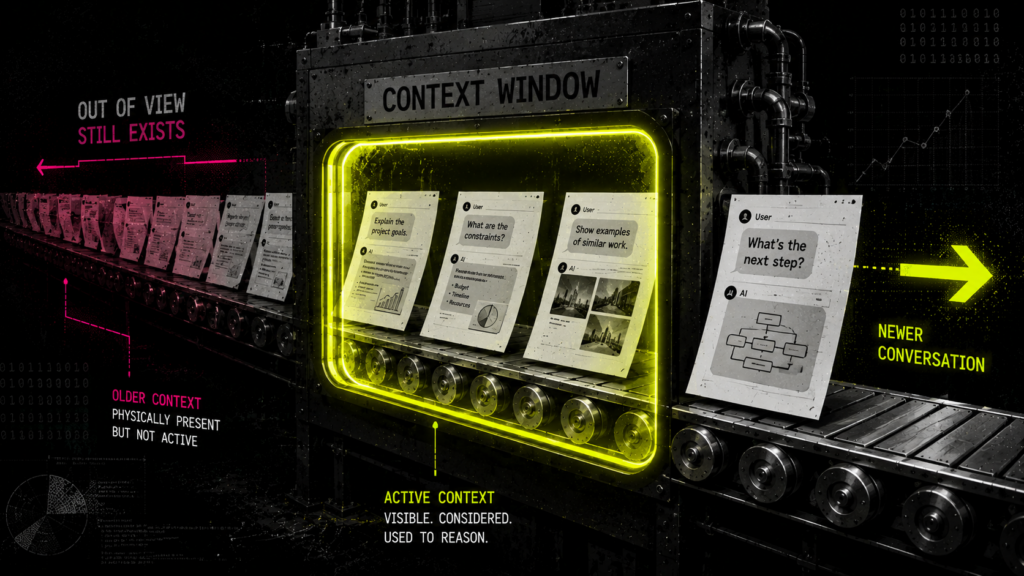
Temporary context is limited. Long conversations can exceed the amount of material the system can actively consider at once, and different products may summarize, compress, or omit older information as the interaction grows.
That does not mean the AI consciously forgot something. It means the information may no longer be present in the active input. This is one reason the context window determines what AI can see right now.
Persistent memory survives beyond one conversation
Persistent memory is different because selected information can remain available later. A system with memory may retain a preference, recurring workflow, project detail, or other useful fact so future conversations can begin with more continuity.
The important distinction is persistence. The information does not need to be repeated in every new chat. If the memory system retains it, the model can use it later even when the original conversation is no longer part of the active context.
Memory is selective rather than a complete transcript
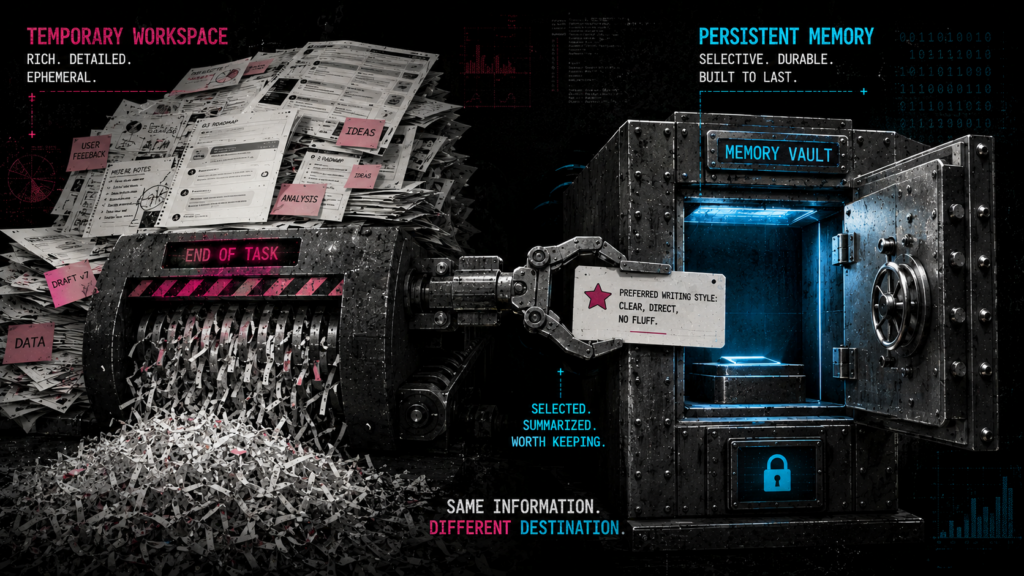
Persistent memory should not be imagined as a perfect archive of everything you have ever said. In many systems, only selected facts are retained, and those facts may be summarized rather than stored as exact conversational history.
This matters because memory is usually designed to preserve useful continuity, not to reproduce every detail. A preference such as your preferred writing style may be worth retaining. A one-time comment about a temporary task may not be.
Context is usually richer but shorter lived
Temporary context can contain far more detail than persistent memory. An entire document, a long sequence of messages, or a large set of instructions may be available during one task. That richness makes context useful for precise work.
Persistent memory is usually more selective. It trades detail for continuity. Instead of carrying the full conversation forward, it preserves the pieces most likely to matter again.
The same fact can exist in both places
A preference can be present in the current conversation and also stored in persistent memory. In that case, the model may receive the same underlying information from two different channels.
This can make the distinction invisible from the user side. The response simply appears consistent. Operationally, however, one copy belongs to the current interaction while the other is available across future interactions.
Memory does not replace source material
Persistent memory is useful for preferences and continuity, but it should not replace authoritative source material when exactness matters. A remembered project detail may be convenient, while the latest contract, specification, dataset, or policy document remains the stronger source.
This is closely related to how giving AI source material changes the quality of its work. Current source material anchors the task to something inspectable instead of relying on a remembered summary.
Memory can become stale
Anything persistent can outlive the situation that made it true. A saved preference may change. A project may be renamed. A workflow may be replaced. A role, tool, or target may no longer apply.
That means persistent memory should be treated as useful context, not permanent truth. When current information conflicts with remembered information, the current instruction or source should take priority.
Good workflows use each layer for a different job
Temporary context is best for the material needed to complete the immediate task: documents, detailed instructions, examples, drafts, and recent decisions. Persistent memory is best for stable preferences, recurring conventions, and information that saves you from repeating yourself.
Keeping those roles separate reduces confusion. You do not need to preserve every project detail forever, and you should not expect temporary context to provide continuity indefinitely.
A useful rule is to ask whether the information is needed for this task or for future continuity. If it only matters to the current work, temporary context is enough. If it is stable, reusable, and likely to change future answers, persistent memory may be appropriate. That distinction keeps temporary detail from becoming permanent clutter.
The practical difference is duration and purpose
Understanding temporary context vs. persistent memory gives you a cleaner model of how AI continuity works. Temporary context is the active workspace. Persistent memory is selected information carried forward. One helps the model solve the task in front of it. The other helps future tasks begin with useful background already in place.