
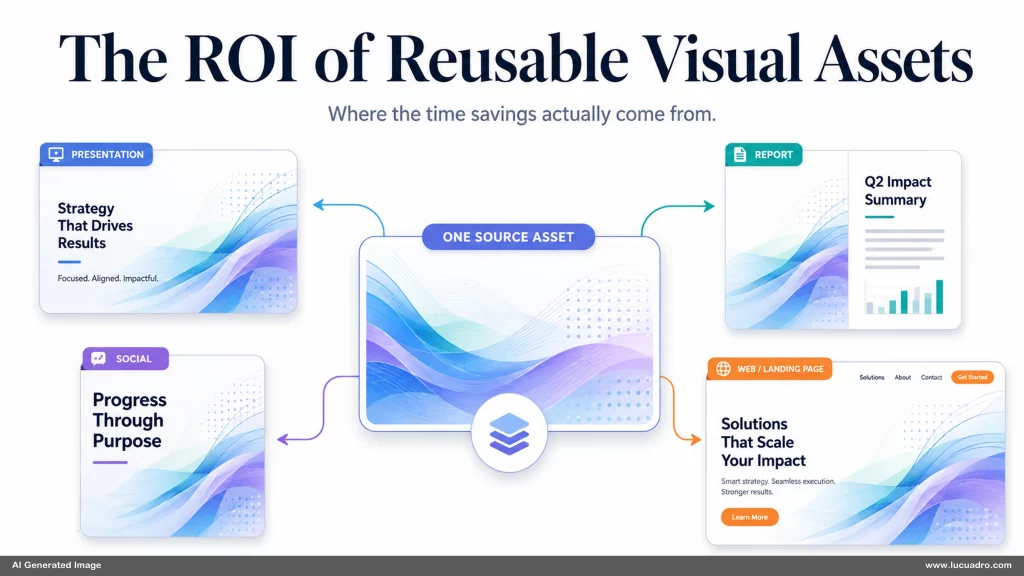
The ROI of Reusable Visual Assets becomes clear when design work repeats. A single background, icon set, character cutout, or transparent element may save only minutes on one job. Across recurring decks, campaigns, documents, and client revisions, those minutes multiply. Reusable visual assets for faster design workflows reduce the hidden time spent searching, recreating, aligning, and adapting material before the real design decisions can even begin.
Reusable Visual Assets Save Time Before Design Even Starts
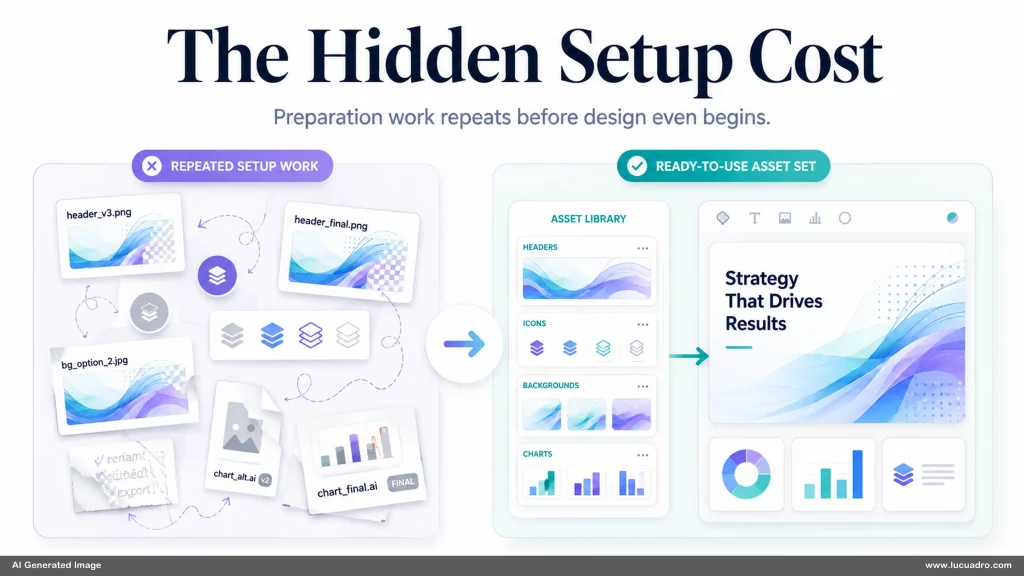
Design time is often measured from the moment a canvas opens, but much of the cost appears earlier. You search through folders, browse libraries, compare options, check resolution, remove backgrounds, rename files, and test whether an asset fits the intended composition. None of that feels like design, yet all of it consumes production time. When the same types of visuals are needed repeatedly, the setup work becomes a recurring tax rather than a one-time inconvenience.
Reusable assets reduce that tax by turning preparation into a previous decision. If you already have a reliable set of business icons, polished backgrounds, or transparent background design elements for presentations and documents, you begin closer to composition. The value is not that every file is instantly correct. The value is that quality, format, and usability have already been checked once, so you do not pay the same search and cleanup cost every time a new brief arrives.
Layered Design Assets Remove the Cost of Rebuilding the Same Visual Logic
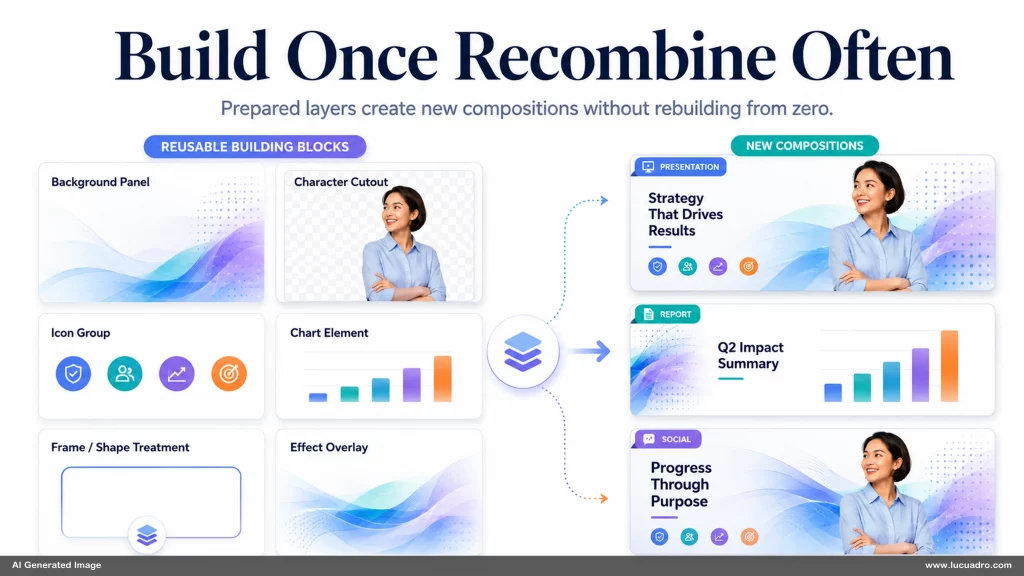
The first use of a reusable asset may not look dramatically cheaper than creating something custom. The second and third uses are where the economics change. Layered design assets you can combine into your own compositions preserve useful building blocks without preserving one fixed arrangement. A shape treatment, frame, character, overlay, or texture can be moved into a different layout, paired with different content, and scaled for a different format without being recreated from zero.
This matters because repeated visual work rarely repeats exactly. A sales deck, training module, and campaign post may share the same visual language while requiring different framing and hierarchy. Locked templates save time only while the new job resembles the original structure. Modular assets travel further. They let you reuse the expensive parts of production while still making new compositional decisions. The savings come from keeping what is still useful instead of choosing between full duplication and full reinvention.
Consistency Is a Time Saving, Not Just a Brand Benefit
Visual consistency is usually discussed as a branding concern, but it also removes decision work. If every new slide or campaign piece starts with an open choice of icon style, illustration treatment, spacing logic, background character, and effects, production slows through repeated micro-decisions. A reusable set narrows those choices. You know which visual family belongs, which assets combine cleanly, and which treatments have already been approved, so fewer iterations are spent making one piece resemble the rest.
Approved assets also reduce review friction. When a visual component has already survived one round of brand, quality, or stakeholder scrutiny, using it again removes part of the approval burden from the next project. The new work still needs judgment, but fewer questions are reopened. That matters in high-volume environments where the cost of waiting for feedback can exceed the cost of making the asset itself. Reuse shortens both production and decision cycles.
The time saving becomes especially visible during revisions. A clinic recruitment campaign may use the same character set, visual effects, and background logic across a landing page, social post, and presentation. When one direction changes, compatible assets make the adjustment easier to carry across the whole set. You are not correcting three unrelated visual systems. You are updating variations of one system, which reduces alignment work and makes the result more coherent at the same time.
The ROI Compounds When One Asset Can Be Adapted Instead of Replaced
The strongest return appears when reuse crosses formats and projects. One well-prepared asset can begin in a presentation, move into a document, become part of a social graphic, and later support a related campaign without losing quality. That is why the useful measure is not time saved on the first use. It is the total number of future sourcing, cleanup, recreation, and consistency tasks that no longer need to happen.
Cross-project reuse also changes the value of organization. A well-named, correctly exported, easy-to-find asset becomes more valuable with every future brief because discovery gets faster while confidence in the file increases. This is why reusable visual assets are closer to production infrastructure than disposable decoration. The investment is partly in the object and partly in making that object dependable enough to return to without another search, cleanup pass, or quality check.
A practical way to think about the economics is to compare replacement frequency. If an asset is too specific, low resolution, or locked into one finished composition, you replace it whenever the context changes. If it is clean, high resolution, transparent where needed, and visually flexible, you adapt it.
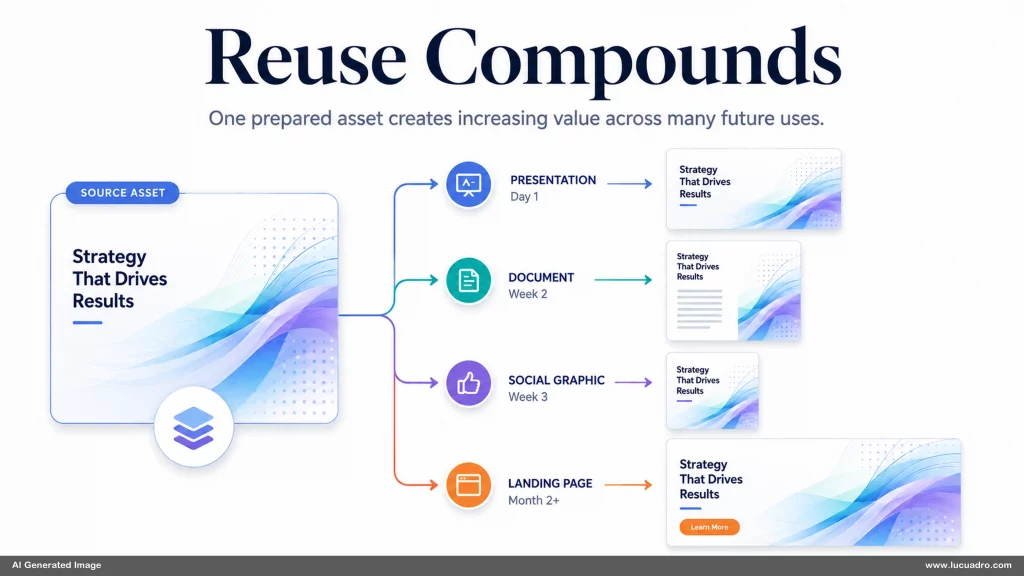
The ROI of Reusable Visual Assets comes from removing repeated work across the full production cycle. Reusable visual assets for faster design workflows reduce sourcing, rebuilding, correction, and adaptation costs every time they return to use. Lucuadro fits that logic by treating visual material as reusable building blocks rather than disposable one-off outputs.