
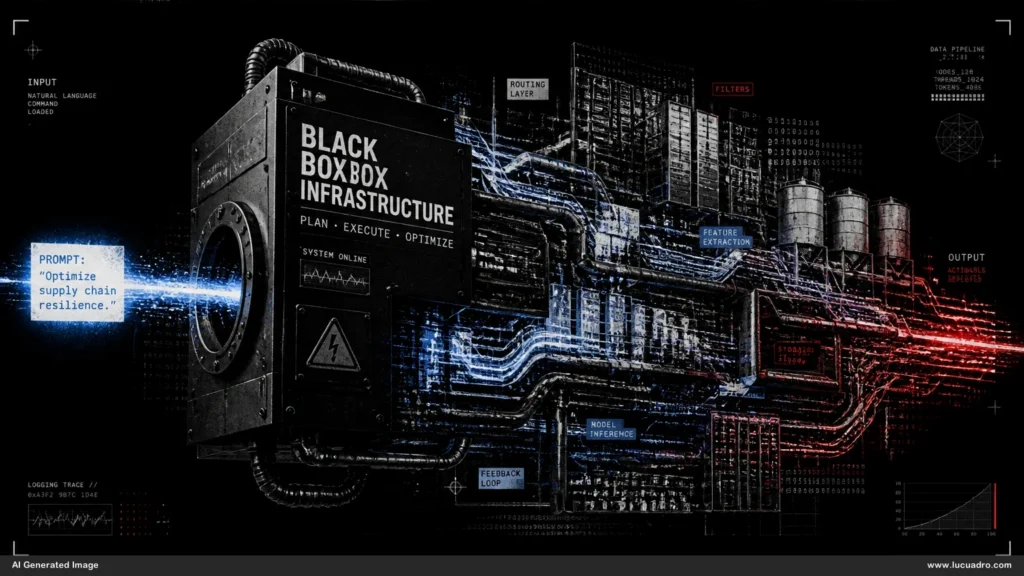
What happens to the data you put into an AI tool depends on more than the model itself. Your prompt may pass through application servers, logging systems, safety filters, storage layers, connected tools, and model infrastructure before a response returns. Some data may be processed only for the immediate request, while other information may be retained for security, product operation, memory, analytics, or model improvement depending on the service and settings.
Your prompt usually passes through more than one system
When you type into an AI interface, the text does not necessarily travel directly from your screen to a model and back. The application may first attach account settings, system instructions, conversation history, tool outputs, or other context needed to complete the request.
The request can also pass through infrastructure that handles authentication, abuse detection, routing, monitoring, and reliability. That means the path of your data is a system-level question, not just a model question.

Processing and storage are different things
Data has to be processed in order for the system to answer. That does not automatically mean it is stored permanently. A service can use information transiently during a request and then discard it, or retain some portion for a defined period.
The important distinction is whether data is merely used to produce the response or kept afterward. Retention policies vary by provider, account type, product setting, legal requirement, and the specific feature being used.
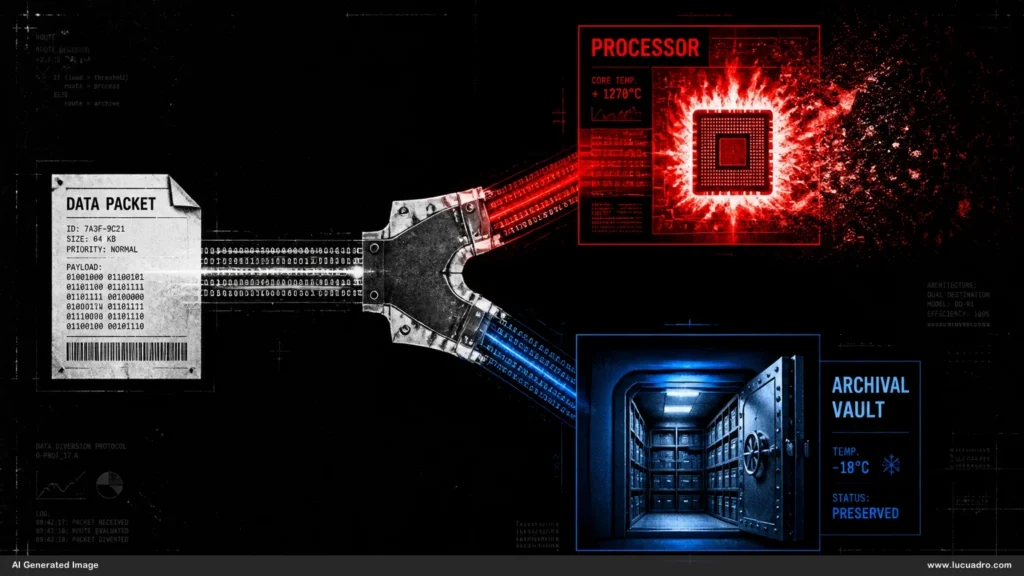
Conversation history can be separate from model training
People often collapse several different ideas into one question: “Does the AI remember this?” A conversation may be stored in your account history without being used to train future models. It may also remain visible to the product while not being part of persistent memory.
Storage, memory, and training are separate mechanisms. This is related to temporary context vs. persistent memory. A piece of information can exist in one layer without existing in the others.

Connected tools can send data outside the core AI service
If an AI can search the web, send email, access files, query a database, or interact with another application, some information may be passed to that external system in order to complete the task.
That creates another data boundary. The AI provider’s policy is no longer the only policy that matters. The connected service may have its own logging, retention, permissions, and security rules.
Uploaded files can contain more sensitive information than the visible prompt
A short instruction can trigger processing of a much larger document. A spreadsheet may contain customer details, internal financial information, hidden columns, comments, or metadata. A PDF may include material beyond the pages you are actively discussing.
Before uploading a file, consider the entire contents rather than only the portion you intend the model to use. The safest input is the minimum information required to complete the task.
De-identification reduces risk but does not make data harmless
Removing obvious names, email addresses, and account numbers can reduce exposure, but context can still identify people or organizations indirectly. A combination of job title, location, transaction details, and dates may be enough to narrow the identity considerably.
For sensitive work, minimization is stronger than cosmetic anonymization. Remove fields the AI does not need instead of assuming that replacing a name with “Person A” solves the privacy problem.
Enterprise and consumer products may have different data rules
Many AI providers offer different contractual and technical controls for consumer accounts, business accounts, enterprise deployments, and API use. These differences can affect retention, training use, administrative access, compliance options, and data residency.
That means a general statement about “AI privacy” is rarely precise enough. You need the policy for the exact product, account type, feature, and configuration you are using.
Current policies matter because data practices can change
Privacy settings, retention periods, model-improvement policies, and product features can change over time. An explanation that was accurate last year may no longer describe the current service.
This is the same freshness problem described in why AI can give you yesterday’s answer to today’s question. If a data-handling decision matters, verify the provider’s current documentation rather than relying on remembered policy details.
Permission boundaries matter as much as retention
Even when data is stored securely, you should ask who can access it and under what conditions. Access may include the account owner, administrators, automated systems, authorized reviewers, connected applications, or service providers.
A useful privacy review therefore looks beyond whether data is saved. It also asks where it travels, who can access it, what purpose that access serves, and how long each copy remains available.
A simple pre-use check can prevent many problems: identify the data category, remove anything unnecessary, confirm the account and product policy, review connected-tool permissions, and decide whether the task really requires the original data at all. In many cases, a smaller excerpt, redacted dataset, synthetic example, or summary is enough to get the benefit without exposing the full source material.
The safest habit is to classify data before you submit it
Understanding what happens to the data you put into an AI tool gives you a practical rule: decide what kind of information you are handling before you paste or upload it. Public material, routine internal information, confidential business data, personal information, and highly sensitive records should not all be treated the same way.
Lucuadro design resources follow a related production principle: only the material required for a visual task should enter the working composition. Clear boundaries make systems easier to control. In AI workflows, data minimization, current policy checks, and deliberate tool permissions give you that same kind of control over information.