
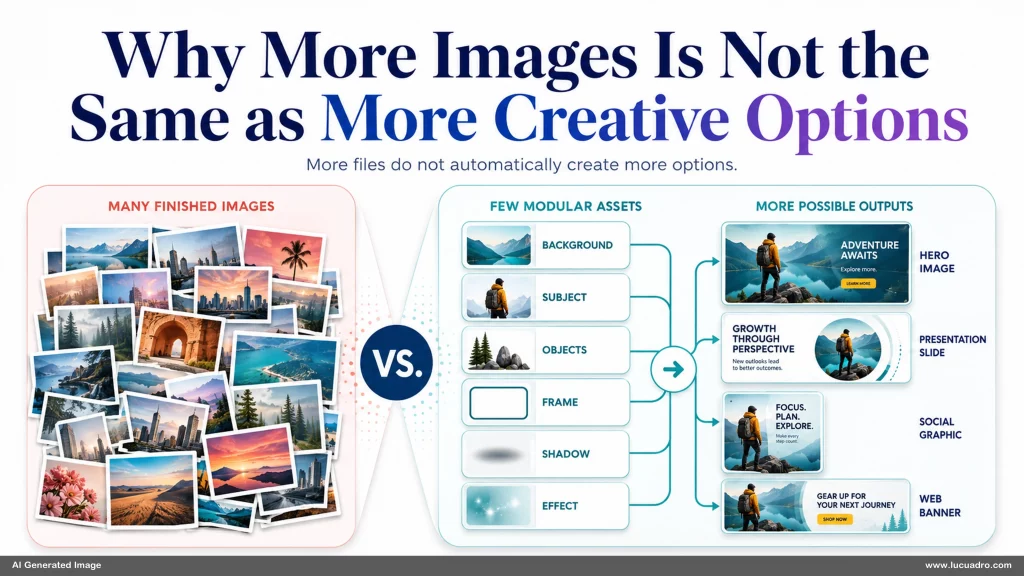
Why “More Images” Is Not the Same as “More Creative Options” becomes obvious once a large asset folder still leaves you rebuilding the same layouts. Volume can give you more subjects, crops, and color treatments without giving you more control over composition. The real constraint is whether the material can be separated, redirected, and combined when the brief changes. More files help only when they expand what you can actually make.
More Images Can Still Leave You With the Same Few Compositions
Image quantity often disguises repetition. A library may contain hundreds of finished scenes, yet most place the subject in the same area, lock the background to the same perspective, and bake lighting or effects into one final frame. When a safety training deck needs the person moved left to make room for a diagram, ten similar finished images may all fail for the same reason. The apparent variety disappears at the moment of use.
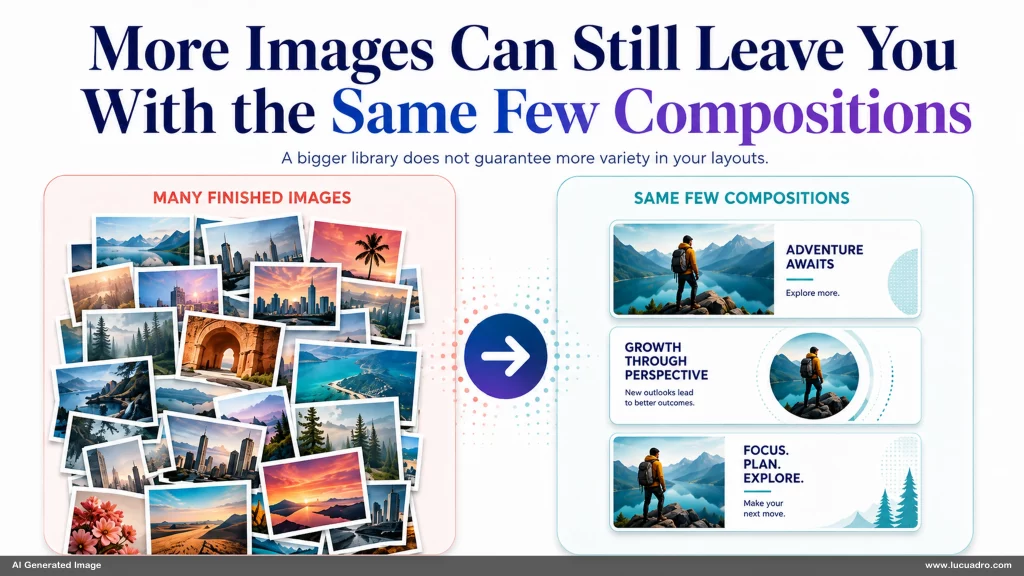
This is why adding another polished image can have sharply diminishing value. If the new file solves the same visual job as five files you already own, it adds selection but little range. A designer still has to crop around fixed decisions, mask unwanted objects, or regenerate the scene. The useful question is whether an asset opens a placement, composition, or combination that was unavailable before. That is the point where quantity starts becoming creative freedom.
The problem becomes especially visible when a collection grows through one-off generation. Each session may produce attractive material, but the files inherit whatever composition happened to work in that moment. Over time you accumulate many final answers to old briefs rather than flexible ingredients for new ones. The folder looks richer while the usable choices remain narrow. Reuse improves when new assets are created to cover missing functions, not merely to add another variation of an existing finished scene.
Layered Design Assets You Can Combine Into Your Own Compositions Multiply the Possibilities
Layered design assets you can combine into your own compositions change the unit of value from finished pictures to reusable decisions. A clean background can accept different subjects. An isolated product can move between a landing page and a presentation. A frame, texture, or effect can support several campaigns without importing the rest of the original scene. Each component remains useful because it can participate in combinations that did not exist when it was created.
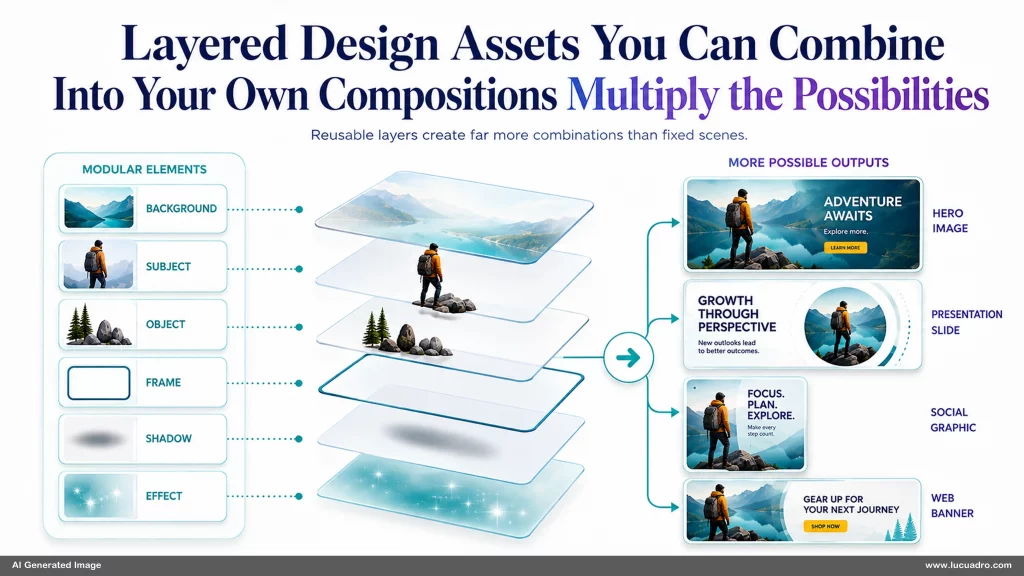
Consider a machine-tool launch that needs a hero image, a comparison slide, and a vertical social creative. Three finished images may satisfy those placements once. A compatible background, isolated machine, operator cutout, shadow, and lighting overlay can support those same placements while preserving the option to change scale, hierarchy, or emphasis later. The smaller component set creates more plausible outputs because the important design choices have not been permanently fused together.
A Design Asset Library Versus Template Shop Changes Where the Creative Decisions Live
A design asset library versus template shop for creative freedom comes down to where decisions are allowed to happen. A template gives you a finished arrangement and asks you to replace content inside it. That can be fast when the arrangement already fits. It becomes restrictive when the message needs a different hierarchy, the product needs a new focal position, or the client wants a visual direction that the template was never designed to support.
Composable assets move those decisions back into the design process. You can choose the background first, place a subject according to the actual copy, add supporting elements only where they help, and preserve negative space for later changes. This does not mean every project should be assembled from dozens of pieces. It means the arrangement remains a choice. The asset library supplies high-quality raw material without deciding the final composition before the brief has been understood.
Creative Range Should Be Measured in Possible Combinations, Not File Count
Creative range is better measured by the number of credible combinations a collection can produce than by the number of files it contains. Twenty isolated components that share perspective, lighting, and visual quality may support more finished work than two hundred unrelated images. Compatibility matters because combinations fail quickly when one element looks pasted in, uses the wrong light direction, or belongs to a different level of realism. More options require both separability and visual fit.
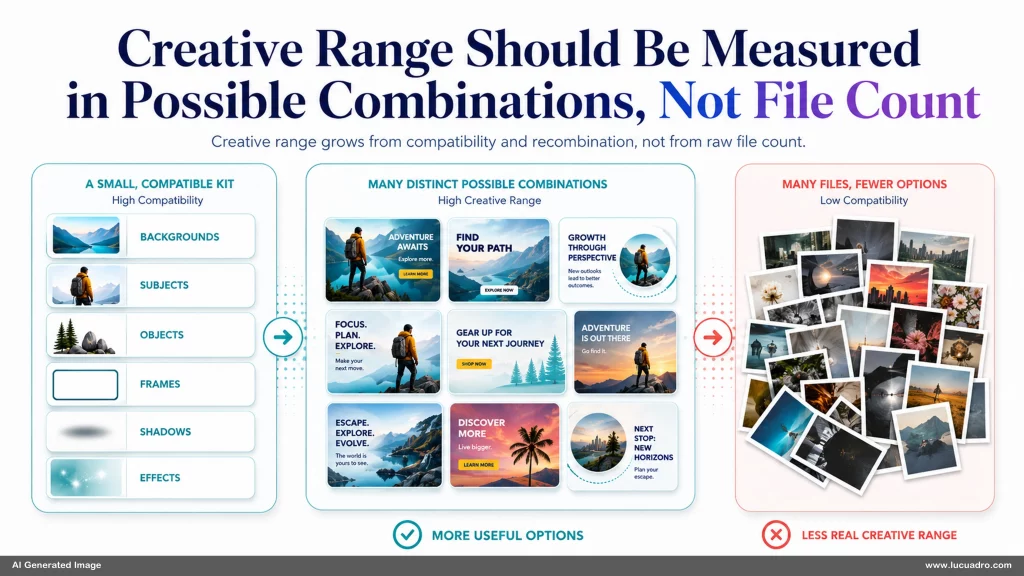
The same standard improves how you evaluate new material. Instead of asking whether an image looks good in isolation, ask what new capability it adds. A background with unusual negative space may unlock several layouts. A second angle of an existing object may make a comparison view possible. A compatible character pose may complete a clinic recruitment page without forcing a new visual style. The strongest additions fill structural gaps rather than simply increasing the folder count.
A practical test is to imagine three future briefs that do not yet exist. If an asset can only survive by being used nearly unchanged, its option value is low. If it can accept another subject, support a different crop, pair with several elements, or preserve useful open space, its option value is higher. This makes creative range easier to judge before the library becomes large enough that file count itself starts looking like evidence of usefulness.
Why “More Images” Is Not the Same as “More Creative Options” is ultimately a distinction between inventory and possibility. Once you judge assets by the combinations they enable, a smaller collection can outperform a much larger one. Lucuadro premium design assets follow that logic by keeping compositional decisions open.