

Why a high benchmark score does not mean an AI is reliable comes down to the difference between measured performance and dependable real-world behavior. Benchmarks can show that a model performs well on a defined set of tasks under controlled conditions. Reliability asks a harder question: will the system continue to perform correctly across unfamiliar inputs, edge cases, changing conditions, ambiguous instructions, and high-consequence situations?
Benchmarks measure a sample, not the whole world
A benchmark contains a finite set of questions or tasks. That makes evaluation possible, but it also limits what the score can tell you. Strong performance shows that the model handled those test cases well. It does not prove that every nearby task will behave the same way.
Real users create a much wider distribution of inputs. They use unusual wording, incomplete context, domain-specific terminology, conflicting instructions, and messy source material. A model can score highly on a clean benchmark while still failing on the kinds of irregular cases that appear in practice.

A single score can hide uneven performance
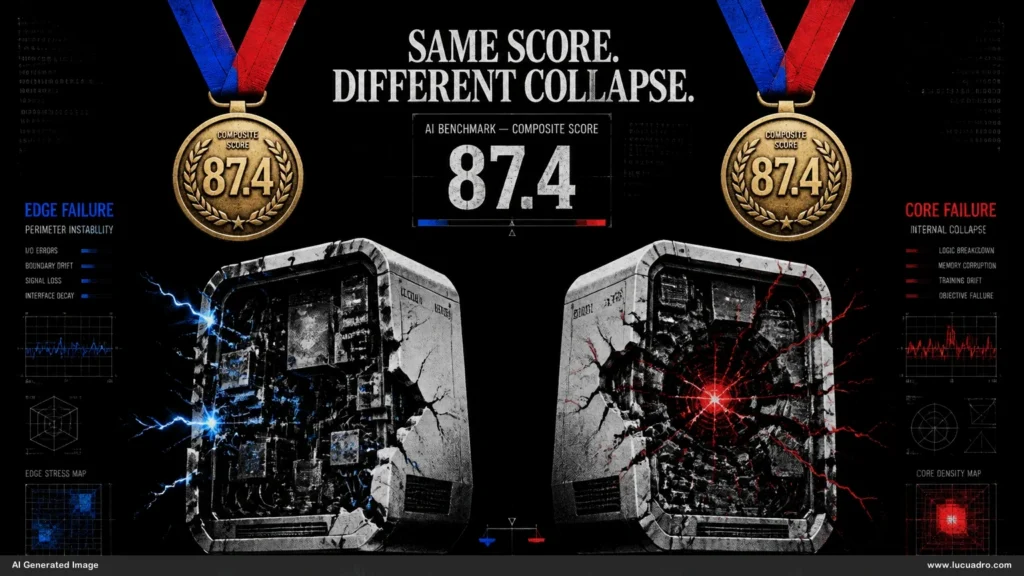
Aggregate scores compress many different results into one number. Two models can receive similar overall scores while failing on completely different categories. One may be strong on common cases and weak on edge cases. Another may be consistent but less exceptional at the easiest tasks.
That matters because your use case may sit inside the weak region rather than the average one. Reliability depends less on the headline number than on how the model behaves on the specific class of tasks you actually care about.
Benchmarks often reward one answer, while real work contains ambiguity
Many evaluations are easier to score when there is a defined correct answer. Real tasks are often messier. A useful answer may depend on missing information, tradeoffs, changing objectives, or interpretation of incomplete evidence.
A model can perform extremely well where the task is clearly specified and still behave unpredictably when the goal itself is ambiguous. Reliability therefore includes judgment about when to ask for clarification, when to abstain, and when multiple answers are reasonable.

Performance can change with small prompt differences
Benchmarks usually control how questions are presented. Users do not. Small changes in phrasing, context, examples, or formatting can change model behavior, especially on tasks near the edge of its capabilities.
This is related to why the same prompt behaves differently across AI models. Model behavior is partly a property of the interaction, not just the underlying capability. A strong benchmark score cannot guarantee stability across every way a task might be expressed.
Benchmark familiarity can inflate apparent capability
Widely used benchmark formats can become familiar to model developers and, indirectly, to the models themselves through training data, synthetic examples, optimization, or repeated evaluation. That does not make the scores meaningless, but it can reduce how well they represent unseen tasks.
The closer evaluation becomes to material the system has effectively practiced, the less it tells you about true generalization. A model that recognizes the style of a test may outperform a model that is equally useful on genuinely novel problems.
Reliability is about consistency, not just peak performance
A model that gets nine difficult questions right and one catastrophically wrong may have the same average score as a model that is slightly less impressive but more stable. Depending on the application, those systems are not equally reliable.
High-consequence work often values predictable minimum performance more than occasional brilliance. You care about how bad the failures are, how often they happen, and whether they can be detected before they cause damage.
Real reliability includes knowing when not to answer
A benchmark may reward producing the correct response, but real systems also need good failure behavior. If the evidence is missing, the safest action may be to express uncertainty, request a source, or refuse to guess.
This connects to why saying “I don’t know” is surprisingly hard for AI. A model that confidently answers every question can look capable while being less trustworthy than a model that recognizes its limits.
Tool use can change performance outside the benchmark
A benchmark may test the model alone, while a production system can include search, calculators, databases, code execution, retrieval, or human review. Those additions can improve reliability dramatically on certain tasks.
The reverse is also true. A benchmark may include tools or scaffolding that your actual workflow does not provide. Comparing scores without understanding the evaluation setup can therefore create false expectations about what the deployed system will do.
Your own failure cases are often more informative
If you use AI for a recurring workflow, build a small evaluation set from the mistakes that actually matter to you. Include difficult examples, edge cases, ambiguous requests, rare terminology, and situations where a wrong answer would be costly.
That private test set may be less glamorous than a public leaderboard, but it measures something closer to operational reliability. The best model for your task is the one that performs consistently where your own workflow puts pressure on it.
A benchmark is evidence, not a guarantee
Understanding why a high benchmark score does not mean an AI is reliable helps put evaluation in the right place. Benchmarks are useful signals of capability, especially when they are well designed, diverse, and hard to game. They are not certificates of dependable behavior across every context.
Lucuadro design resources use the same principle in visual production. A single impressive sample says less than repeated performance across real compositions, formats, and constraints. Reliability appears when quality holds up across variation, not when one test produces an excellent result.