

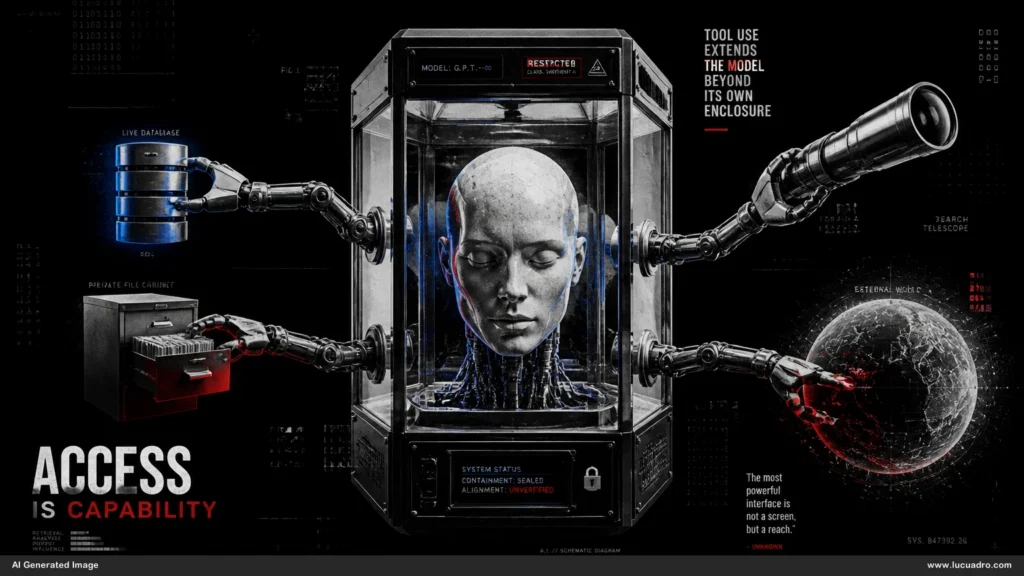
Why AI becomes more powerful when it can use tools is easy to understand once you separate language ability from action. A language model can reason over text, generate ideas, explain concepts, and transform information. Tool use extends that ability into the outside world. Search, calculators, code, databases, calendars, files, and other systems let the model retrieve current information, perform exact operations, and act on resources it could not otherwise access directly.
Tools give AI access to information beyond its immediate context
A model can only work with what it already knows and what appears in the current conversation. That is often enough for general explanation, but it becomes a limitation when the task depends on live data, private documents, or specific records.
A search tool can retrieve current information. A file tool can open a supplied document. A database connector can query records. The model still has to interpret what it receives, but the information no longer has to be guessed from memory or inferred from a short prompt.
Tools separate language generation from exact operations
Some tasks are poorly suited to free-form generation. Arithmetic, code execution, sorting large datasets, converting formats, or checking a database are better handled by systems designed for those operations.
AI becomes more reliable when it can delegate those parts of the task. The model can decide what calculation is needed, send it to a calculator, and then explain the result. It can write code, execute it, inspect the output, and revise the approach. The language model handles interpretation while the tool handles the operation.

Tool use can make current information available
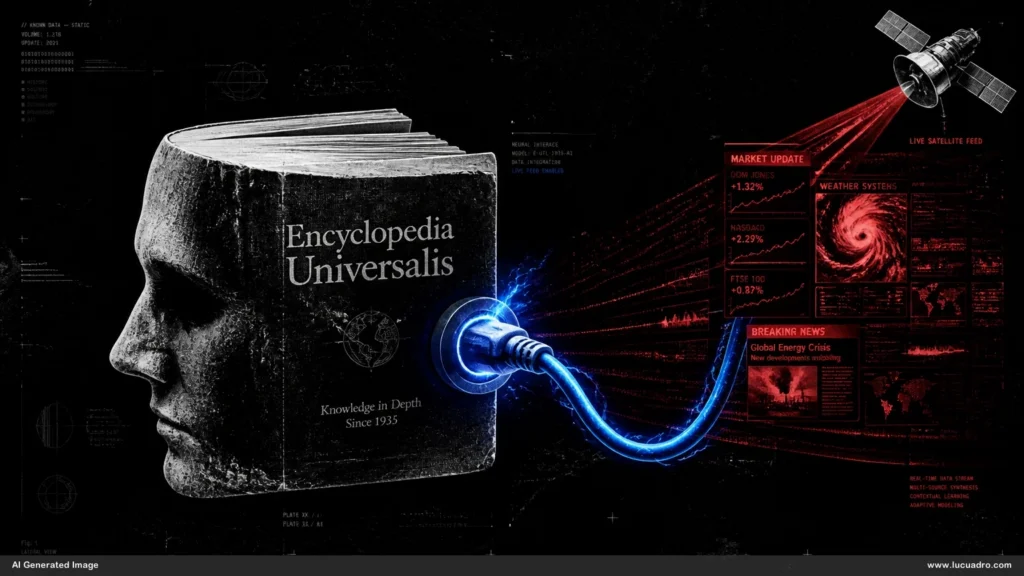
Many questions depend on facts that change. Prices, schedules, weather, software versions, company information, news, inventory, and market data can become outdated quickly. A model without access to a current source may produce a plausible answer that is no longer correct.
Tools change that by allowing retrieval at the time the question is asked. This does not remove the need for judgment because the model can still misunderstand a source or choose a weak one. It does, however, replace stale recall with direct access to more current evidence.
Tools make private and project-specific work possible
General model knowledge cannot know the contents of your private files, inbox, calendar, project database, or internal documentation unless those resources are made available. Tool access lets AI work with information that is specific to your actual environment.
This is closely related to giving AI source material. The difference is that a tool can retrieve the relevant source when needed instead of requiring you to paste everything into the conversation manually.
Tool use turns some AI systems from responders into operators
Without tools, the model mainly returns information. With the right permissions, it may also create a calendar event, update a document, run an analysis, query a service, generate a file, or send a structured request to another system.
That changes the role of the model. It can participate in a workflow rather than only describe what the workflow should contain. The value increases because fewer steps have to be translated manually from an AI response into another application.
Several tools can be combined into one workflow
The strongest systems often use more than one tool. A model might retrieve a document, extract relevant figures, calculate a result, compare it with another source, and produce a formatted report. Each tool handles a different part of the task while the model coordinates the sequence.
This is where context becomes especially important. As explained in why better context makes AI dramatically more useful, the model needs a clear objective and constraints. Tool access expands capability, but context tells the system which capabilities to use and toward what end.
Tool use also changes how AI can recover from uncertainty. Instead of guessing a missing fact, the model can search for it. Instead of estimating a calculation, it can run one. Instead of assuming what is inside a file, it can inspect the file directly. The system still needs to choose the right source and interpret the result correctly, but it has more ways to replace uncertainty with evidence.
This matters because many weak AI answers come from answering beyond the information available. A tool-enabled workflow can make “go and check” part of the process rather than relying on fluent approximation.
More capability also creates more ways to fail
A model can choose the wrong tool, provide the wrong arguments, misread the result, repeat an action unnecessarily, or carry an early mistake into later steps. The problem becomes more serious when the tool can change external systems rather than only retrieve information.
That is why permissions, verification, and checkpoints matter. Read-only access may be appropriate for research. High-impact actions may require confirmation. Exact calculations should still be checked when the stakes are high. Tool use increases what AI can do, so the design of the surrounding controls matters more as well.
The best division of labor matches each task to the right mechanism
Language models are strong at interpretation, synthesis, planning, explanation, and flexible pattern matching. Deterministic tools are stronger at exact calculation, retrieval, storage, execution, and structured operations. Combining them lets each mechanism handle the part it is better suited for.
Understanding why AI becomes more powerful when it can use tools helps explain why practical AI systems can be far more capable than a standalone chat model.