

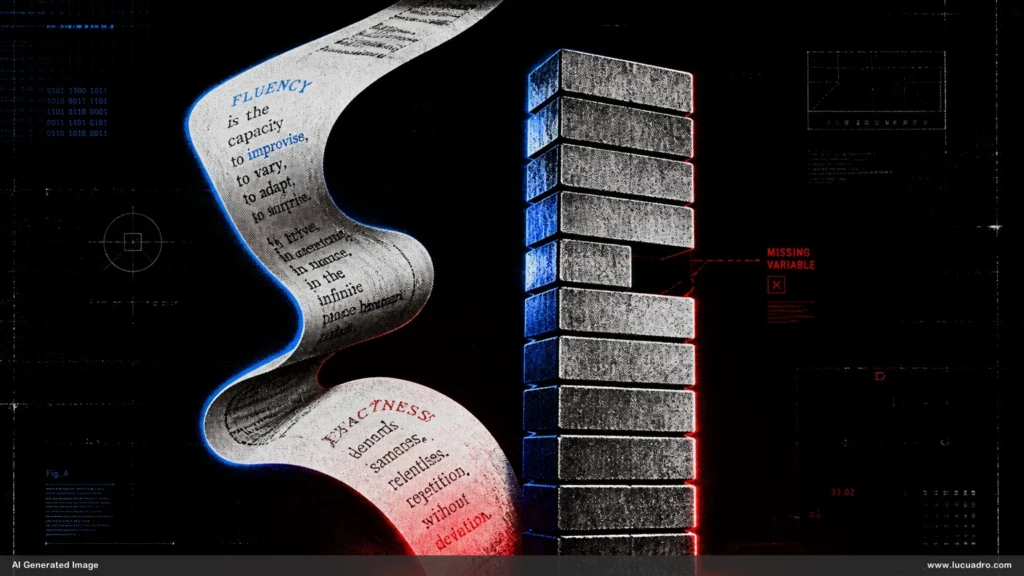
Why AI can write beautifully and still miscount simple things becomes easier to understand once you separate language generation from exact computation. A model can produce elegant prose because it has learned rich patterns in language, structure, tone, and association. Counting, arithmetic, and exact symbolic operations demand a different kind of reliability. When the task shifts from producing a plausible continuation to preserving exact quantities, the model’s strengths no longer line up perfectly with the problem.
Fluent language and exact calculation are different capabilities
Writing depends heavily on pattern recognition. A model can learn how explanations usually unfold, how arguments are structured, how tone changes with audience, and how words tend to fit together. That makes it strong at tasks where many different outputs can still be acceptable.
Counting is less forgiving. If there are 17 items, the correct answer is 17. There is no nearby stylistic alternative that is equally valid. A system optimized for plausible generation can therefore look extremely capable in prose while remaining less dependable on exact symbolic tasks.
Language models process tokens, not objects in the human sense
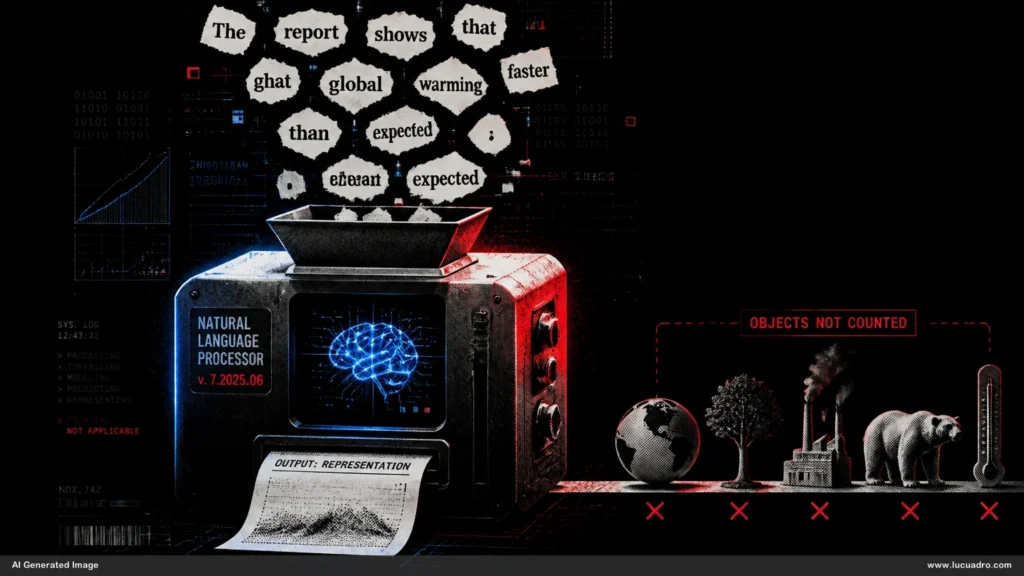
Text is broken into units called tokens before the model processes it. Those units do not always correspond neatly to whole words, characters, or the visual objects a person thinks they are counting. A sequence that looks simple to you may be represented internally in a less intuitive way.
This matters for tasks such as counting letters, tracking repeated items, or performing exact manipulations across long sequences. The model is not necessarily scanning the input with a built-in counter. It is predicting outputs from learned representations of the sequence.
Plausibility can hide small numerical errors
A polished response creates an impression of competence. That can make a simple counting error feel surprising because the surrounding language is so coherent. But fluency and numerical correctness are not strongly coupled.
The model may generate a result that fits the surrounding pattern even when one element has been skipped or counted twice. The answer can still sound deliberate because the same language system explains the result smoothly. Presentation quality does not prove computational accuracy.

Exact tasks expose weaknesses that prose can conceal
Many language tasks tolerate approximation. A summary can use different wording and still be accurate. An explanation can choose one example instead of another. A paragraph can be reorganized without becoming wrong.
Counting has no such flexibility. The smaller tolerance makes errors easier to detect. This creates the odd impression that a system capable of sophisticated analysis somehow fails at something elementary. The difficulty is not necessarily conceptual complexity. It is the requirement for exact state tracking.
Long sequences make exact tracking harder
The risk increases when the model must maintain many small details across a long input. Counting repeated words, checking whether every item in a list appears exactly once, or tracking a sequence of intermediate calculations requires stable bookkeeping.
Language models can lose track of that state. A missed item early in the process may propagate into the final answer even if the reasoning around it remains fluent. This is similar to the limitation described in why asking AI to check its own work only goes so far: the same system can preserve a hidden mistake through multiple passes.
Breaking the task into steps can improve reliability
Exactness often improves when the task is made more explicit. You can ask the model to enumerate the items first, group them, show intermediate results, and then total them. That reduces how much invisible bookkeeping has to happen at once.
Still, decomposition does not create mathematical certainty. It simply gives the model a clearer structure and makes errors easier to inspect. For important calculations, an exact tool remains preferable.
Deterministic tools are better at exact operations
A calculator, spreadsheet, database query, or short program is designed to execute fixed operations consistently. Once the rule is specified correctly, the result does not depend on which continuation happens to be most probable.
This is why AI becomes more powerful when it can use tools. The model can interpret the request and decide what operation is needed, while a deterministic system performs the counting or calculation exactly.
The best division of labor depends on the error tolerance
If you are generating ideas, rewriting prose, comparing arguments, or explaining a concept, small variation may be acceptable or even useful. If you are totaling invoices, checking inventory, validating a financial model, or counting contractual obligations, the tolerance is much smaller.
The more exact the task, the more useful it is to separate interpretation from execution. Let the model handle ambiguity and language. Let a deterministic tool handle the operation that must be numerically correct.
Simple-looking tasks can demand exact mechanisms
Understanding why AI can write beautifully and still miscount simple things helps remove a misleading assumption: difficulty for humans and difficulty for AI are not ordered the same way. Producing a coherent essay may align closely with what a language model is built to do, while exact counting may require a mechanism it does not perform reliably by generation alone.