
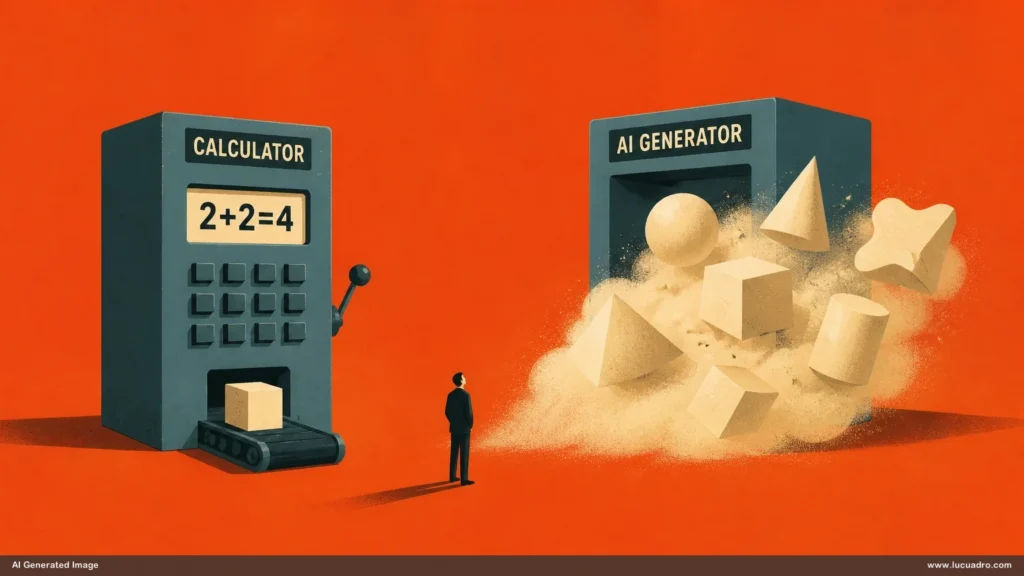
Why AI is probabilistic instead of deterministic matters because it explains why the same model can produce different answers to nearly identical requests. Traditional software usually follows fixed instructions: the same input leads to the same operation and, under the same conditions, the same output. Generative AI works differently. It produces responses by assigning probabilities to possible continuations, which makes the system flexible but also introduces variation, uncertainty, and occasional inconsistency.
Deterministic software follows explicit rules
In deterministic software, the program specifies what should happen for a given input. A calculator does not improvise the result of 18 multiplied by 7. A sorting function does not choose a different order because another arrangement feels plausible. The rules of the operation determine the result.
This makes deterministic systems dependable for tasks where exactness matters. If the inputs and conditions remain the same, the output is expected to remain stable as well. That predictability is one of the main reasons traditional software works so well for calculation, storage, transaction processing, and other tightly defined operations.

Generative AI chooses among many plausible continuations
A language model does not normally retrieve one prewritten sentence that exactly matches your prompt. It evaluates many possible continuations and assigns different probabilities to them based on patterns learned during training and the context currently available.
That means several different answers can all be plausible. One response might explain a concept with an analogy, another might lead with a definition, and another might organize the same material into steps. The model is selecting from a distribution of possible outputs rather than following one rigid path.
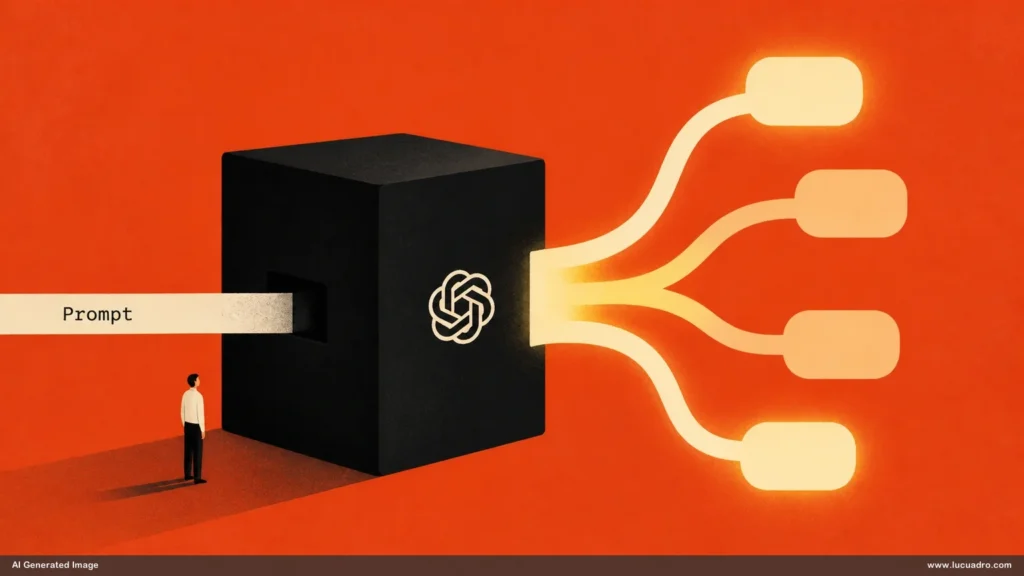
Probability is what gives generative AI flexibility
If a generative model always followed the single most obvious continuation, its output would often become repetitive and rigid. Probabilistic generation allows it to explore less obvious wording, examples, structures, and creative directions while still staying close to the patterns implied by the prompt.
This is part of why AI can create alternative headlines, rewrite a paragraph in several tones, generate different visual concepts, or explain the same idea in multiple ways. The system is not limited to one predetermined answer. Its flexibility comes from working across a range of plausible possibilities.

The same prompt can produce different answers
Because generation involves probability, repeated runs can diverge even when the prompt is unchanged. The differences may be small, such as wording or order, or larger, such as the examples chosen or the structure of the response.
Some systems expose controls that influence how much variation is allowed. Others manage those settings automatically. Either way, the underlying principle remains: the model is not executing a single fixed script. It is producing one path through a space of possible outputs.
Probabilistic does not mean random
The word probabilistic can sound as if the model is simply guessing at random. That is misleading. The probabilities are highly structured by the training data, the current context, the instructions, and the relationships the model has learned.
A common continuation may receive much more probability than an unusual one. A strong prompt can narrow the range substantially. Source material can narrow it further. The result is still probabilistic, but the distribution can become tightly concentrated around outputs that fit the task.
Context changes the probability distribution
Every useful piece of context changes what becomes more or less likely. If you specify the audience, goal, format, terminology, and source material, many irrelevant continuations become less plausible while a smaller set becomes more likely.
This is one reason better context makes AI dramatically more useful. You are not rewriting the model’s internal rules. You are reshaping the space of likely outputs so the model has fewer reasons to wander into irrelevant territory.
Probabilistic generation is useful until exactness becomes the requirement
Flexible generation is excellent for drafting, brainstorming, explanation, comparison, synthesis, and creative variation. It becomes less suitable when the task requires a single exact result, such as a precise calculation, database lookup, or transaction.
In those cases, AI works better when paired with deterministic tools. As explained in why AI becomes more powerful when it can use tools, the model can handle interpretation while a calculator, database, or other specialized system handles the exact operation.
Variation can be useful information
Different outputs are not always a defect. Running the same creative or analytical task several times can reveal alternative framings, expose assumptions, or show which parts of a prompt are underspecified. Variation can help you see the range of interpretations the model considers plausible.
The useful question is whether the task benefits from that range. For creative exploration, variation may be the point. For a compliance calculation, it is a warning sign. Understanding the role of probability helps you decide when variability is valuable and when it needs to be constrained.
Reliability comes from matching the mechanism to the task
Understanding why AI is probabilistic instead of deterministic makes its behavior much easier to interpret. The model is designed to generate plausible continuations across a range of possibilities, not to behave like a fixed calculator for every problem. That gives it unusual flexibility, but it also means exactness and consistency need to be engineered when they matter.