

Why AI is great at patterns but bad at reality becomes clear once you separate recognition from verification. Generative AI is remarkably good at finding structure in language, images, examples, and large information sets. It can detect recurring forms, predict likely continuations, reorganize messy material, and produce convincing variations. The weakness appears when success depends on whether something is actually true in the external world rather than whether it fits the pattern.
Pattern recognition lets AI do useful work without understanding reality directly
Much of what makes AI impressive comes from learning relationships between things. Words appear near other words. Visual forms recur. Certain document structures repeat. Certain questions tend to receive certain kinds of answers. By learning those relationships at massive scale, AI becomes good at producing outputs that fit the statistical structure of the material it has encountered.
This is enough to power many valuable tasks. AI can classify information, summarize recurring themes, transform one format into another, propose likely categories, generate alternatives, and recognize structural similarities that would take a person far longer to process manually. In these cases, the usefulness comes from the pattern itself. The system does not need to independently inspect the outside world for every step.
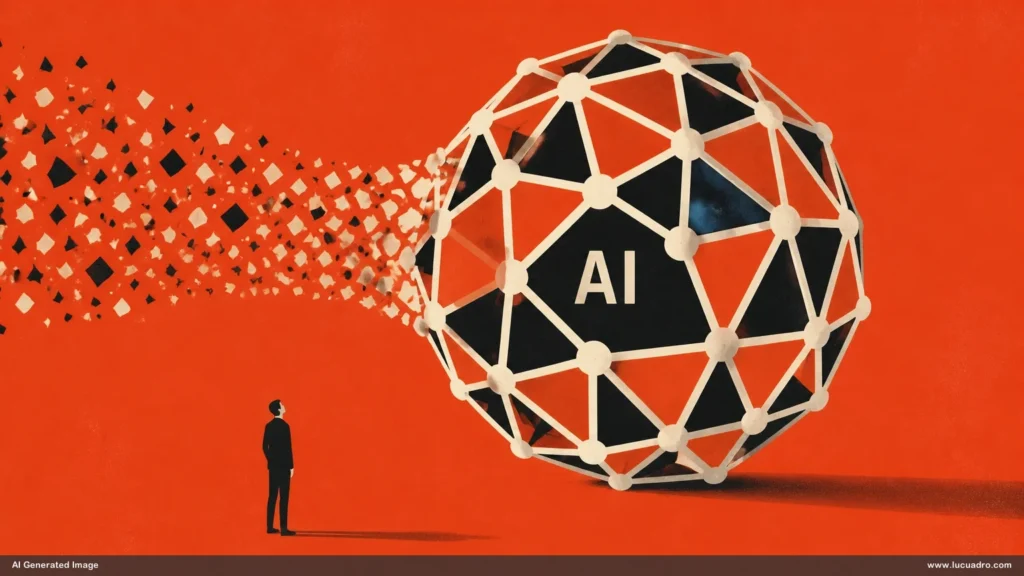
Reality requires external checks that pattern matching cannot provide
Reality is less forgiving. A number is either accurate or it is not. A product exists or it does not. A law applies or it does not. A source says something or it does not. A machine component fits a specification or it does not. These questions cannot be settled by producing the most plausible continuation of a pattern. They require contact with evidence outside the generated answer.
This is where AI can fail in ways that feel surprising. It may produce an answer that is structurally perfect while one factual premise is wrong. It may give a coherent explanation built around an outdated assumption. It may generate a convincing detail because the surrounding context strongly predicts what that detail should look like. The model’s internal consistency does not force correspondence with reality.

AI can be more reliable with structure than with isolated facts
A useful way to think about AI performance is that relationships are often easier for it than isolated truth claims. Give it fifty customer comments and ask what themes recur, and pattern recognition is exactly the task. Give it a disorganized project brief and ask for a cleaner structure, and the source material constrains the answer. Give it ten examples of a visual style and ask what they have in common, and it can often extract the repeated characteristics extremely well.
Now change the task. Ask for the exact current price of a product, the latest regulation, the true author of an obscure quotation, or whether a specific event happened yesterday. Pattern knowledge may help generate a plausible answer, but the task is no longer primarily about structure. It is about correspondence with external reality. That requires retrieval, source access, measurement, or another form of verification.

The same pattern strength explains both AI usefulness and AI hallucinations
The strength and the failure come from the same mechanism. AI is useful because it can complete patterns extremely well. It can also hallucinate because a plausible completion can exist even when the corresponding fact does not. This is why a false answer can have the right tone, vocabulary, format, and internal logic. The system is not necessarily failing at pattern generation. It may be succeeding at pattern generation while failing at factual grounding.
This explains why AI gives confident wrong answers. The polished surface is part of the model’s competence. Confidence in the prose tells you that the pattern is strong, not that the claim has been independently checked. Once you understand that, hallucinations stop looking like a mysterious contradiction and start looking like a predictable edge case of a pattern engine.
Better AI workflows give the model strong reality anchors
The practical response is not to avoid AI. It is to reduce the amount of reality the model has to invent. Provide source documents. Use retrieved information. Supply examples. Give reference images. Constrain the task with real data, measurements, approved claims, or known assets. Then use AI for the part it handles best: transformation, synthesis, comparison, generation, and recombination.
This is particularly powerful in visual work. If you ask AI to invent a complete person, environment, product, composition, lighting setup, and brand treatment from nothing, every layer is open to drift. If you supply strong inputs and ask the model to modify, combine, or restyle them, much more of the result is anchored. The same logic explains the value of reference images for AI image generation.
AI becomes easier to trust when you use it for the right class of problem
The most useful dividing line is simple. Use AI confidently when the task depends mainly on patterns inside supplied material or on generating structured possibilities. Increase scrutiny when the task depends on external truth. A rewrite, synthesis, clustering exercise, composition study, or variation task lives mostly in pattern space. A factual claim about the world lives in reality space and deserves a source.
Understanding why AI is great at patterns but bad at reality gives you a more precise way to decide where it belongs in a workflow. You can push it hard on recognition, transformation, structure, variation, and recombination while adding verification wherever the output crosses into factual claims about the external world.