
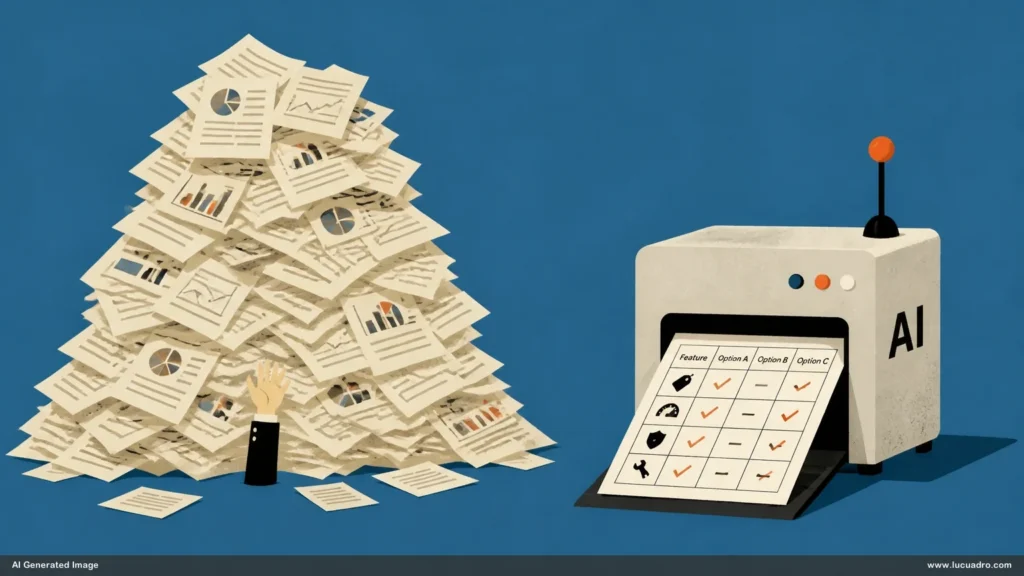
Why AI is so effective at comparing large amounts of information becomes clear when you look at the kind of work comparison actually requires. You have to hold multiple sources in mind, notice similarities and differences, track repeated themes, separate important changes from minor ones, and keep the comparison consistent across the whole set. AI is well suited to that pattern-heavy workload, especially when the material is supplied directly and the comparison criteria are clear.
Comparison is really a pattern-recognition problem
Comparing two documents is easy when the difference is obvious. Comparing twenty documents, fifty customer comments, or hundreds of product descriptions is harder because attention starts to fragment. You forget what appeared earlier, overemphasize recent examples, and struggle to apply the same criteria consistently across every item. The problem is not usually intelligence. It is working memory and repetition.
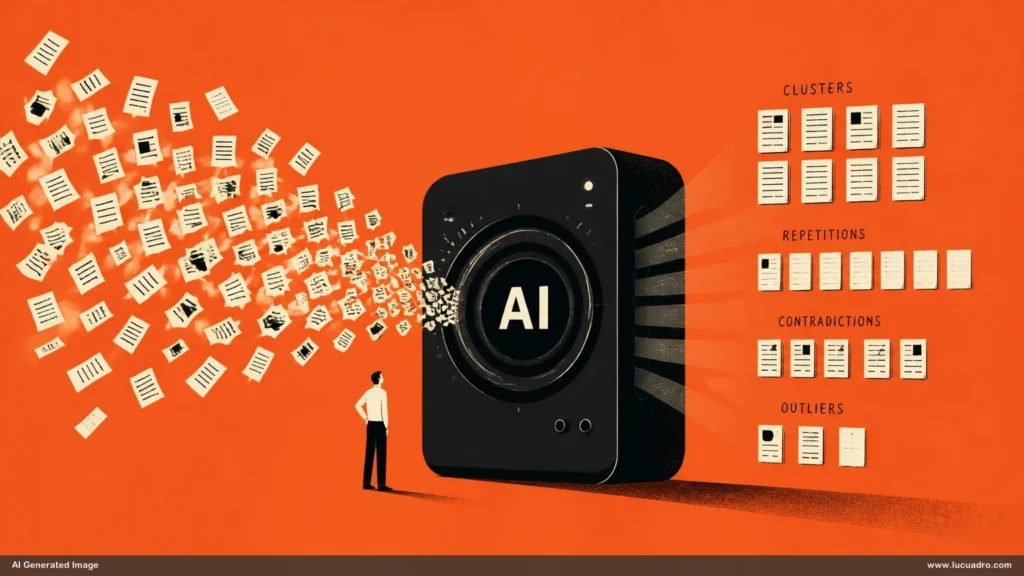
AI handles this differently. It can inspect many examples in one pass, look for recurring structures, and group similarities without becoming bored or losing track of earlier material in the same context. That makes it particularly useful for questions such as which themes recur, where two documents disagree, which items share the same attributes, or which examples are unusual compared with the rest.
AI can apply the same comparison criteria again and again
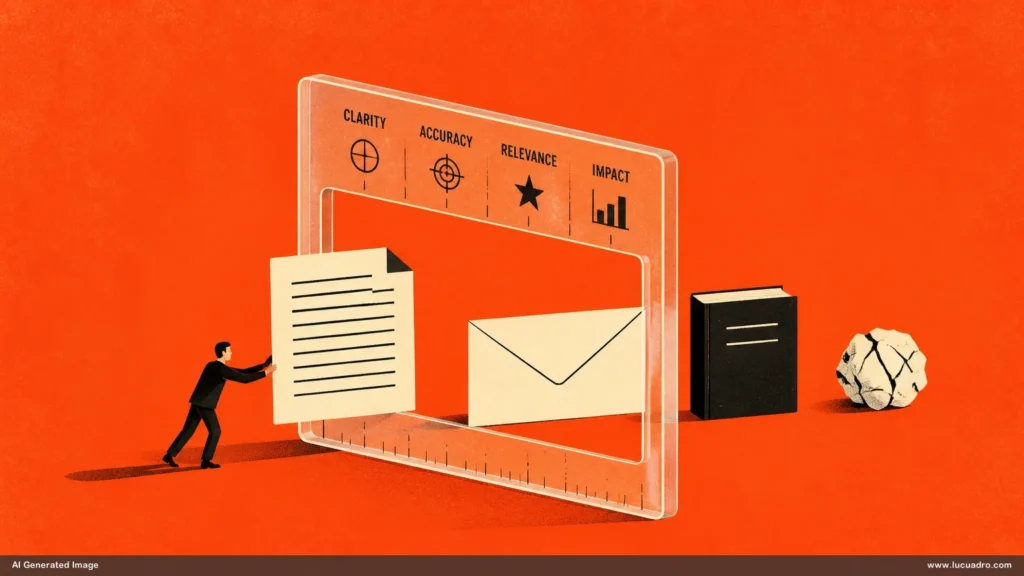
Consistency is one of the hidden difficulties in manual comparison. You may begin by judging documents on five criteria, then gradually shift emphasis as you read. A model can be instructed to use the same dimensions across every item: price, claim, tone, evidence, feature set, risk, visual style, or any other category relevant to the task.
The output becomes much more useful when those criteria are explicit. Instead of asking AI to compare ten options generally, ask it to compare them on the factors that matter to the decision. This creates a repeatable frame and reduces the chance that the result drifts into whatever differences happen to be easiest to describe. The structure of the comparison matters as much as the model’s ability to process volume.
Large comparisons become easier when AI compresses the information first
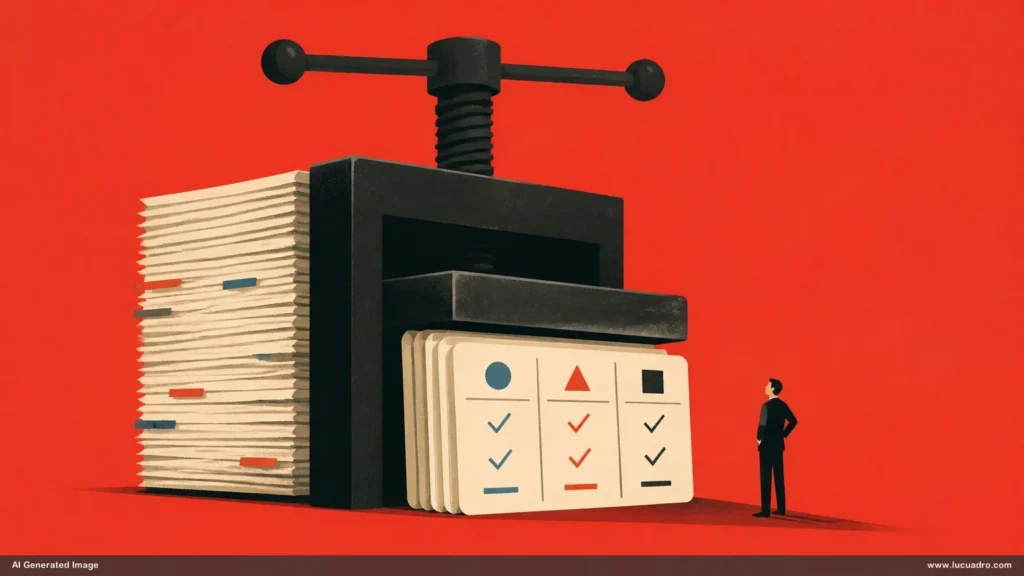
Raw comparison gets difficult when every source contains too much detail. AI can first reduce each source into a smaller representation, then compare those representations. A long report can become a set of claims, evidence, assumptions, and recommendations. A group of product pages can become a table of features and limitations. A visual reference set can become recurring traits in composition, lighting, palette, framing, and subject placement.
This kind of compression is powerful because it reduces the amount of information you have to reason over at once. The model can preserve the source-level detail for later inspection while creating a simpler layer for comparison. That is closely related to using AI to summarize and structure information, where the goal is to expose useful relationships without losing access to the original material.
AI can reveal differences that are easy to miss manually
Some comparisons are difficult because the differences are subtle rather than dramatic. Two contracts may use almost identical language but assign responsibility differently. Two strategy documents may agree on the problem but recommend incompatible actions. Two visual concepts may share the same palette while differing in hierarchy and negative space. When the material is dense, these distinctions are easy to overlook.
AI can surface these small structural differences because it is not relying on a quick visual impression. It can compare wording, categories, sequences, repeated terms, and relationships across the full set. This does not guarantee that every detected difference matters, but it gives you a broader field of candidate differences to inspect. The model is especially helpful when the task is to find what changed, what repeats, or what does not fit the dominant pattern.
Comparison works best when the source material is bounded and available
AI is strongest when it can compare information you actually provide. If you upload documents, paste source material, or give the model access to a defined collection, the comparison is grounded in something concrete. You can check where a conclusion came from, verify an apparent contradiction, and ask for direct supporting passages.
This is different from asking for a comparison based on unspecified knowledge. In that case, the model may omit an important source, rely on stale information, or fill gaps with plausible assumptions. The closer the task stays to a bounded information set, the more dependable the comparison becomes. That distinction reflects why AI is good at pattern recognition: structure inside the supplied material is easier to analyze than facts outside it are to verify.
The best role for AI is to narrow the field for human judgment
Comparison is rarely the final decision. A model can identify patterns, rank differences, cluster similar options, and highlight outliers, but the importance of those differences still depends on your goal. A five percent price difference may matter enormously in one context and hardly at all in another. A design variation may be technically minor but strategically decisive.
Understanding why AI is so effective at comparing large amounts of information helps you use that strength without handing over the judgment itself. Let AI process volume, apply consistent criteria, compress sources, and surface differences. Then evaluate which differences actually matter. That same division of labor works well in creative production, where Lucuadro visual asset library materials give you a strong comparison set and AI helps reveal which visual choices best fit the intended result.