

Why AI is so good at extracting specific information from text becomes clear once you notice how often useful facts are buried inside unstructured language. Names, dates, decisions, requirements, risks, prices, locations, action items, and technical details may all appear inside paragraphs rather than neat fields. AI can scan that language, identify the patterns that matter, and return the requested information in a more usable form without requiring you to read every line manually.
Extraction is different from summarization
A summary asks what matters overall. Extraction asks for a specific type of information. That distinction matters because the model is not being asked to compress the whole source into a general overview. It is being asked to find and return particular items while ignoring most of the surrounding text.
You might ask for every deadline in a document, every company mentioned in a transcript, every action item in meeting notes, or every numerical claim in a report. The source stays the same, but the task changes according to the field you want to recover.

Language models are strong at recognizing recurring information patterns
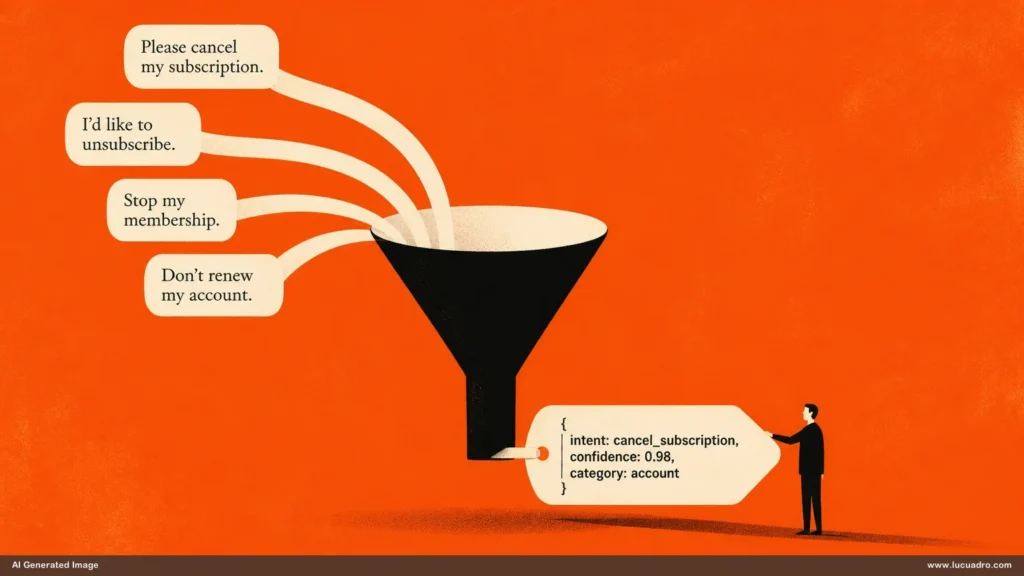
Specific information rarely appears in one fixed format. A deadline might be written as a date, a relative phrase, or a sentence describing when something must happen. A customer complaint might use several different words while expressing the same underlying issue. Traditional keyword matching can miss those variations.
AI can recognize meaning across different phrasings. That makes it useful for extracting categories that are semantic rather than purely literal. Instead of searching only for the word “deadline,” you can ask for all passages that indicate a due date or time constraint. The model can often identify several linguistic forms of the same information type.
Structured output makes extracted information easier to use
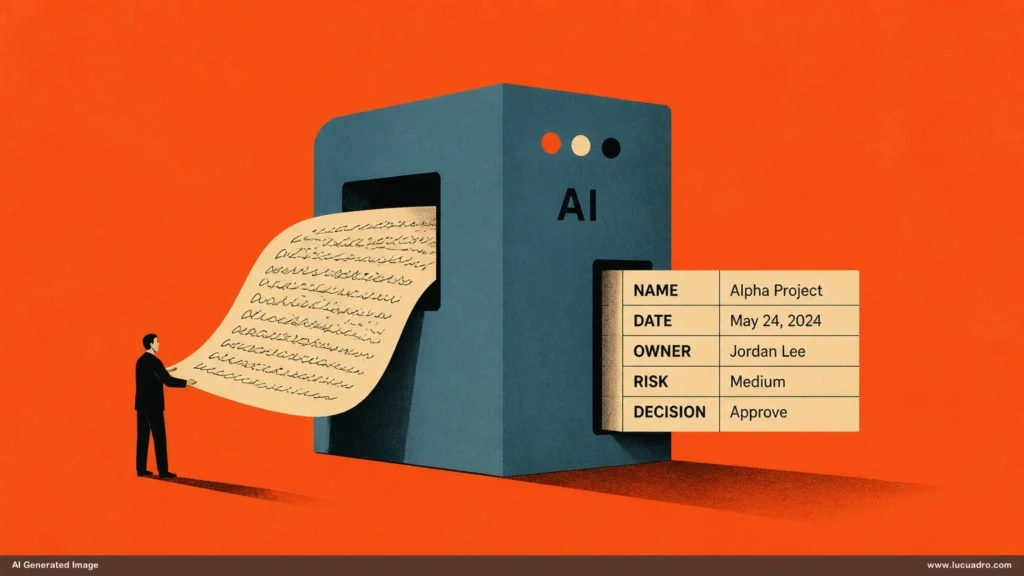
The real value often appears after extraction. Once information is pulled from prose, it can be organized into a consistent structure such as a list of names and roles, a set of requirements, or a sequence of decisions with supporting context. That structure makes the information easier to compare, filter, review, and transfer into another workflow.
This connects directly to turning unstructured information into useful structure. Extraction is often the first step. The model identifies the pieces you care about, then places them into a form that is easier to inspect than the original text.
Extraction becomes more reliable when the target is precisely defined
Broad instructions produce broad interpretation. “Find the important information” leaves the model to decide what importance means. “Extract every deadline, owner, and unresolved decision” defines a much clearer task. The more concrete the target, the easier it is to judge whether the output is complete.
You can also define what should not be included. If you only want explicit dates, say not to infer implied deadlines. If you want direct customer objections, exclude the analyst’s interpretation. Good extraction prompts narrow the model’s freedom because the task is closer to information retrieval than open-ended writing.
Source-bounded extraction is especially useful for repetitive work
Many work processes involve reading similar documents repeatedly. Applications, contracts, support tickets, research notes, interview transcripts, survey responses, and project updates often contain the same categories of information in different wording. AI can apply one extraction frame across many sources.
That creates consistency. Instead of one person noticing pricing while another notices timing, every document can be checked for the same fields. The model can return the requested categories in the same order each time, making later comparison easier.
Extraction can reveal information that is easy to overlook
Humans are good at understanding context but can miss small details in long material, especially when the detail appears only once. A single exception, qualification, number, or dependency may be buried inside an otherwise familiar document. Asking AI to inspect the source for one category can surface those details more systematically.
This is closely related to using AI to compare large amounts of information. Once the same fields are extracted from several sources, differences become easier to see. Extraction creates the common representation that comparison needs.
The biggest risk is plausible extraction rather than faithful extraction
AI can sometimes return information that fits the requested pattern but was not actually present in the source. It may infer a missing value, merge two nearby details, or restate something more confidently than the text supports. That is especially dangerous when the output looks clean and structured because the format can make it feel authoritative.
For important tasks, ask the model to stay source-bound and preserve the original wording where practical. Request supporting quotes or source locations for extracted items. If a field is absent, instruct the model to mark it as missing rather than infer it. Extraction quality improves when uncertainty is allowed to remain visible.
The strength comes from turning reading into targeted retrieval
Understanding why AI is so good at extracting specific information from text helps you use it for one of its most practical strengths. Instead of asking the model to understand everything equally, define the information you need and let it locate recurring patterns across the source. The result is faster review, cleaner structure, and easier comparison.