
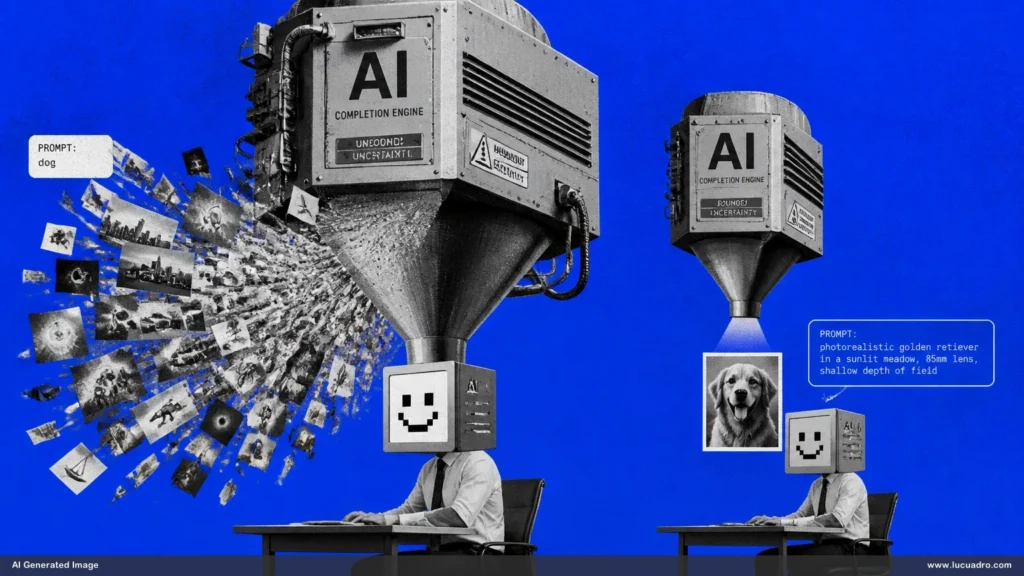
Why better context makes AI dramatically more useful is simple: the model can only work with the information and constraints it can see. A vague request forces it to guess your goal, audience, standards, terminology, and priorities. A well-contextualized request removes much of that uncertainty. The result is usually more relevant, more precise, easier to verify, and closer to the form you actually need.
Context reduces the amount of guessing AI has to do
A short prompt can leave dozens of important variables undefined. If you ask for a presentation outline, the model may not know whether the audience is technical, executive, educational, or commercial. It may not know whether the goal is persuasion, explanation, decision support, or training. Each missing variable creates room for a plausible but unhelpful assumption.
Context narrows that space. A few lines about the audience, objective, constraints, source material, and desired output can eliminate entire categories of irrelevant responses before generation begins.

Good context tells AI what must remain stable
Useful work often depends on preserving certain things exactly. A brand voice, product specification, legal clause, visual identity, audience level, terminology set, or source position may not be negotiable. If those elements are not provided, the model may substitute generic patterns that appear reasonable.
Context creates anchors. You can tell the model which facts are fixed, which references should guide the work, and which dimensions are open for variation. That makes the output more controlled because creativity happens around the stable parts instead of replacing them.

Source material is one of the strongest forms of context
Instructions describe what you want. Source material shows the model what you are working with. Giving AI the actual report, transcript, product information, examples, previous draft, or reference image reduces the need to reconstruct the problem from a short description.
This is why giving AI source material can change the quality of its work so substantially. The task becomes grounded in concrete material rather than only in the model’s general patterns. That can improve fidelity, consistency, and relevance at the same time.

Context improves relevance more than extra instructions alone
Longer prompts are not automatically better. Repeating instructions, adding decorative detail, or describing the desired quality in vague adjectives may add length without reducing uncertainty. The useful question is whether each piece of information changes how the model should perform the task.
“Make it professional” is weak context because it does not define what professional means. “Write for operations managers who already understand the process but need a one-page decision brief” is stronger because it changes tone, depth, vocabulary, and structure. Good context is operational.
Examples can define quality more precisely than adjectives
People often describe creative preferences with words such as clean, premium, bold, simple, or sophisticated. Those terms are broad. Two people can use the same adjective while imagining very different results.
An example, reference, or previous successful output gives the model a more concrete target. It can infer relationships between structure, tone, density, pacing, composition, and emphasis that would be difficult to describe completely. This is especially useful in writing, design, image generation, and other tasks where quality depends on many interacting choices.
Better context makes iteration more cumulative
Without context, every new generation can drift. You fix the tone, then lose the structure. You improve the composition, then the audience fit changes. You ask for another version and the model silently reinterprets parts of the brief.
A stable context package makes each iteration build on the previous one. The core objective, source material, constraints, and standards remain fixed while one chosen variable changes. This connects to faster creative iteration with AI. Speed becomes more valuable when each pass stays inside the same problem definition.
Context can also carry history. If you are continuing a project, previous decisions, rejected directions, established terminology, and earlier drafts help prevent the model from solving the same problem again from scratch. That continuity matters because useful AI work often happens across several passes rather than one isolated prompt.
There is a practical limit, however. Context should be relevant enough to guide the task. Dumping every available document into the conversation can bury the important signal. Strong context is selective: it includes what changes the answer and leaves out what does not.
Context helps the model expose uncertainty instead of hiding it
Good context can also define what the model should do when information is missing. You can instruct it to mark unknown fields, separate evidence from inference, preserve conflicting source claims, or identify assumptions that would need confirmation. That prevents the model from smoothing over gaps simply to produce a complete-looking answer.
This is especially important for research, analysis, and decision support. A response that clearly shows where the source ends is more useful than one that quietly fills the gaps with plausible language.
The best context is usually structured around the task
A practical context package often includes the objective, audience, source material, fixed constraints, evaluation criteria, and output format. Not every task needs all of them, but each category removes a different kind of uncertainty. The point is not to write the longest prompt possible. It is to supply the information that actually changes the result.