

Why asking AI to check its own work only goes so far comes down to shared failure modes. A model can often improve an answer by reviewing it, spotting inconsistencies, tightening logic, or comparing the result against explicit criteria. But the reviewer and the original writer are still the same underlying system. If the model missed a fact, misunderstood the task, or accepted a false assumption the first time, a second pass may reproduce the same mistake with more confidence.
Self-review can catch surface-level problems
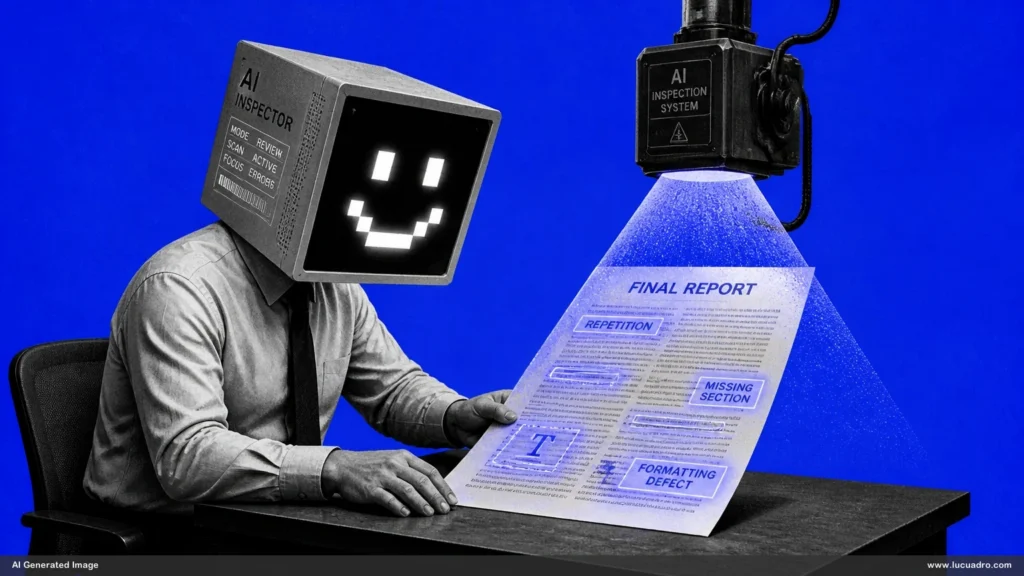
AI is often good at finding issues that are visible in the text itself. It can notice repetition, unclear structure, inconsistent terminology, missing sections, formatting errors, and obvious contradictions. It can also compare a draft against a checklist and identify requirements that were not followed.
This makes self-review useful for cleanup. A second pass can improve coherence and compliance because the model now has both the instruction and its own completed output to inspect. The task has changed from generation to evaluation, which can expose problems that were easier to miss during the first pass.
The same blind spot can survive both passes
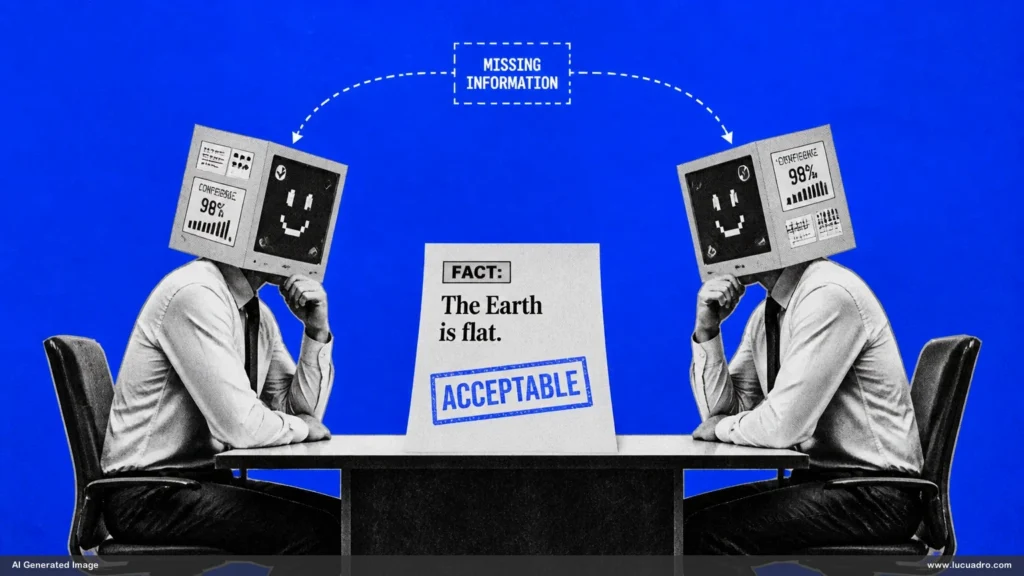
The limitation appears when the error is not obvious from the generated text. If the model confidently invented a date, misunderstood a technical distinction, or relied on a weak assumption, the same internal knowledge may support that mistake during review.
The model can effectively ask itself, “Does this look plausible?” and answer yes for the same reason it produced the mistake in the first place. Repetition does not automatically introduce new evidence. Without a different source of information, the second pass may only reinforce the original reasoning.
Checking against criteria is stronger than vague self-critique
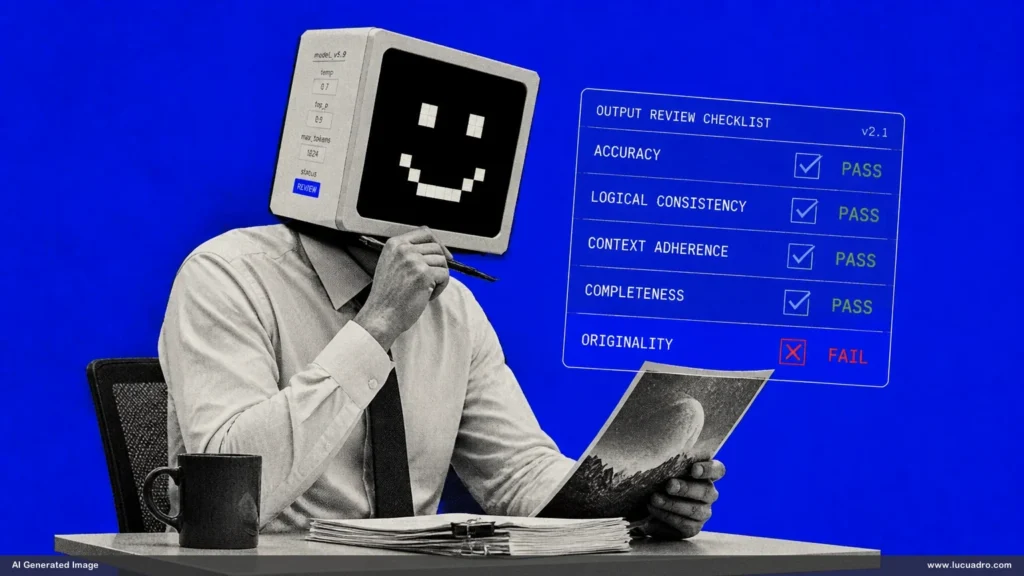
“Check your work” is a weak instruction because it does not define what should be checked. A stronger review asks the model to test specific properties: verify every numerical claim, compare each section against the brief, identify unsupported assumptions, check whether all requested fields are present, or flag statements not grounded in the supplied source.
Specific criteria change the task from general reflection into structured inspection. The model has a clearer standard and is more likely to find concrete failures. The quality of self-review therefore depends heavily on the quality of the review procedure.
External evidence is what breaks the loop
If accuracy matters, the strongest check introduces information that was not part of the original generation. A calculator can verify arithmetic. A database can confirm a record. Search can verify a current fact. A source document can establish whether a quotation or claim is actually supported.
This is why AI becomes more powerful when it can use tools. A second model pass is still interpretation. An external tool can provide independent evidence.
A different model can help, but independence is limited
Using another model as a reviewer can reduce some correlated errors because the second system may have different training, tuning, or reasoning tendencies. It may notice something the first model missed.
But two models can still share the same misconception or rely on the same widely repeated false information. Model diversity is useful, yet it is not equivalent to factual verification. Agreement between models increases confidence only when their errors are sufficiently independent, which is often hard to know.
Self-checking works better for constrained tasks
The more explicit the task, the easier it is for AI to verify its own output. A model can check whether every required heading exists, whether a paragraph stays within a word limit, whether a JSON object contains the expected fields, or whether a supplied document supports a specific statement.
Open-ended judgments are harder. Asking whether an argument is truly persuasive, whether a forecast is realistic, or whether a strategy will work in the real world requires standards and evidence that may not exist inside the current context.
Fluency can make weak reviews look convincing
AI can produce a polished critique even when the critique is incomplete. A response that lists several strengths and weaknesses may feel rigorous because it has the surface form of an audit. That presentation quality should not be confused with independent validation.
This is especially important when reviewing factual claims. The model can explain why a claim seems reasonable without proving that it is true. The difference between plausibility and evidence remains even when the model is acting as its own critic.
Human review is most valuable at high-consequence points
Human judgment should focus on decisions where an undetected error would matter. That may include final factual approval, strategic choices, legal or financial interpretation, public claims, or creative decisions with reputational consequences.
The goal is not to manually redo everything AI produces. It is to apply human attention where the model cannot independently validate the result. As human judgment and AI speed work so well together explains, review becomes more valuable when it is concentrated at high-leverage checkpoints.
The best check changes the information available
Understanding why asking AI to check its own work only goes so far gives you a more reliable review strategy. Self-critique is useful for structure, consistency, compliance, and obvious errors. Stronger verification introduces explicit criteria, independent tools, authoritative sources, or human judgment that the original generation did not have.