
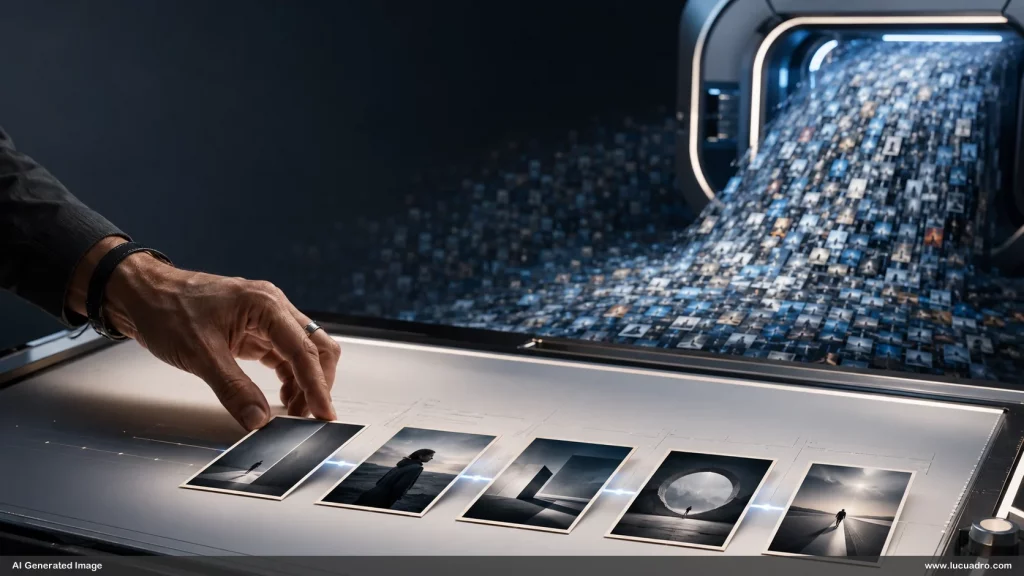
AI image generation has created a strange illusion.
Because images can now be produced in seconds, it appears that visual creation itself is becoming less valuable.
Type a prompt. Generate four options. Select one. Publish it.
What once required a photographer, illustrator, designer, retoucher, studio, equipment, and several days of production can now happen during a coffee break.
The obvious conclusion is that creative work is becoming automated.
But that conclusion confuses production with direction.
AI is making image production abundant. It is not making visual judgment abundant.
In fact, the opposite is happening.
As the number of images grows, the ability to decide what should be made, what should be selected, how it should be arranged, and whether it is actually good becomes more important.
This is the central paradox of generative AI:
The easier it becomes to produce images, the more valuable it becomes to know which images deserve to exist.
AI does not eliminate art direction.
It exposes the absence of it.
And in a world where visual production becomes nearly unlimited, human taste, selection, sequencing, restraint, and visual judgment become the scarce resources.
The Real Shift Is Not From Human Creativity to Machine Creativity
The common narrative around AI image generation is simple.
Machines are learning to create.
Humans are becoming less necessary.
But that is not the most useful way to understand what is happening.
AI image generators do not arrive with goals, brand instincts, cultural awareness, strategic priorities, or an understanding of what an audience should feel.
They do not know whether a campaign should look authoritative or intimate.
They do not understand whether a product should feel premium, rebellious, safe, technical, playful, nostalgic, or transformative.
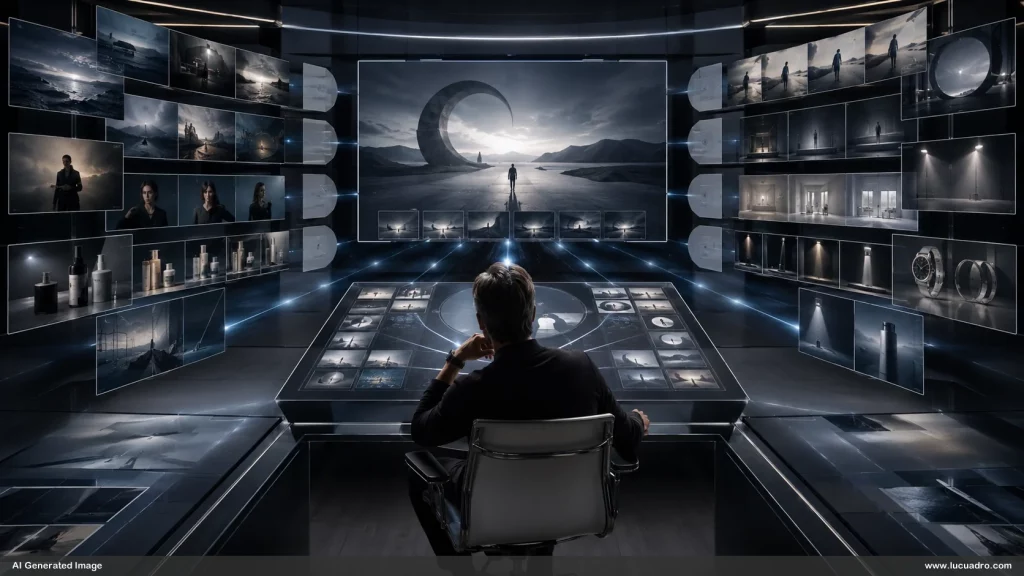
They do not know which image is on-brand.
They do not know which visual idea is overused.
They do not know when an image feels too polished, too artificial, too dramatic, too familiar, too complicated, or simply wrong.
They can produce.
They cannot care.
They can imitate.
They cannot decide what matters.
They can generate visual possibilities at extraordinary speed, but possibility is not direction.
The real shift is therefore not from human creativity to machine creativity.
It is from manual production to automated production guided by human judgment.
That distinction matters.
When cameras became widely available, photography did not become meaningless. More people could take photographs, but the value of composition, timing, storytelling, editing, and selection remained.
When desktop publishing became accessible, design did not disappear. More people could place text and images on a page, but good typography, hierarchy, spacing, and visual communication remained difficult.
When digital video tools became cheaper, filmmaking did not become automatic. More footage could be produced, but editing, pacing, narrative, and emotional control became even more important.
Generative AI follows the same pattern, only faster and at a much larger scale.
It lowers the cost of creating options.
It does not remove the need to choose among them.
Image Production Is Becoming Abundant
For most of visual history, production was the bottleneck.
A company might have had a strong idea for an advertisement but lacked the budget to shoot it.
A small business might have needed dozens of campaign visuals but only been able to afford three.
A marketer might have imagined several concepts but lacked the design skill to execute them.
A presentation designer might have needed custom illustrations but settled for stock photography.
A creative team might have wanted to test ten visual directions but only had time for two.
AI changes that.
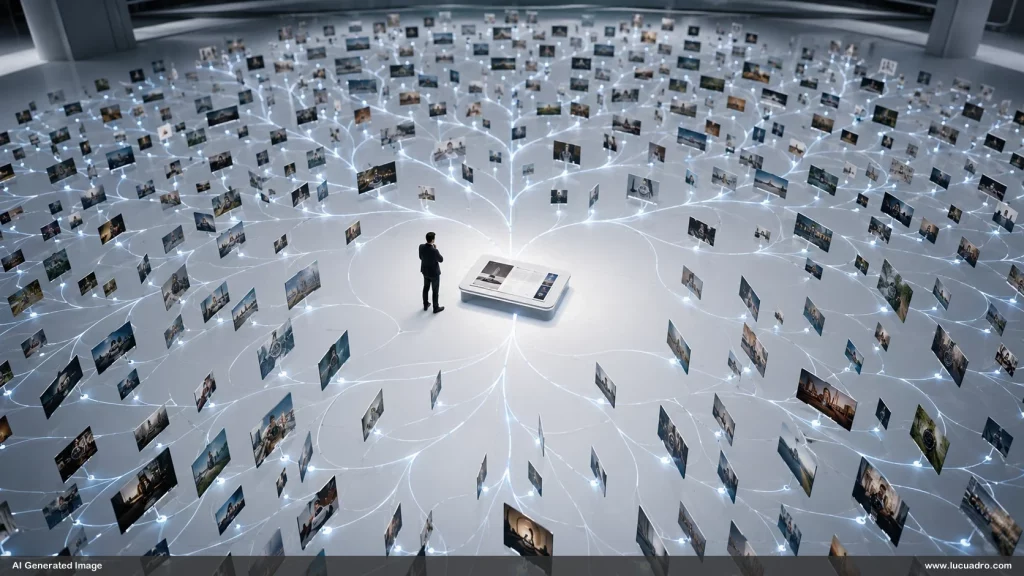
Now a single person can generate:
- twenty campaign concepts in an afternoon
- multiple product environments without building physical sets
- different lighting conditions without reshooting
- dozens of visual styles without hiring separate specialists
- localized image variations for different markets
- alternate compositions for multiple platforms
- rapid drafts for ads, presentations, landing pages, packaging, and social content
The production ceiling is disappearing.
But when production becomes abundant, a new problem appears.
You no longer struggle to get an image.
You struggle to identify the right image.
You no longer struggle with a lack of options.
You struggle with an excess of them.
This is not a smaller problem.
It is a more demanding one.
Scarcity forces decisions because only a few things can be made.
Abundance makes decisions harder because nearly anything can be made.
A creative team that once reviewed twelve photographs may soon review twelve hundred generated variations.
A brand that once created one campaign per quarter may now be able to create ten.
A content team that once published three original visuals per week may soon be capable of publishing three hundred.
At that point, generating more is no longer the advantage.
Knowing when to stop becomes the advantage.
Art Direction Begins Where Generation Ends
Many people misunderstand art direction as making images look attractive.
That is only a small part of it.
Art direction is the discipline of giving visual form to an intention.
It connects strategy to imagery.
It translates an abstract goal into a coherent visual experience.
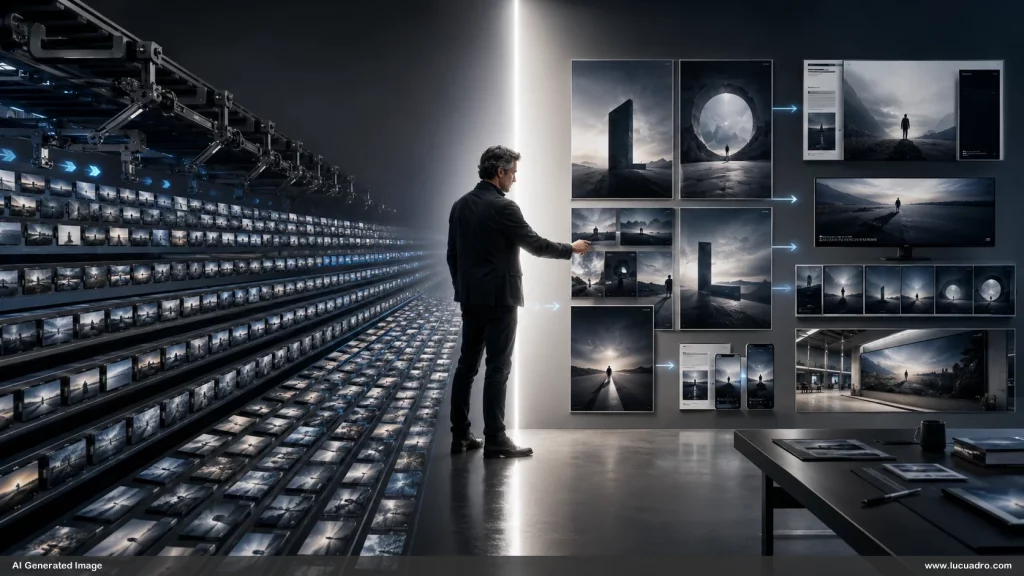
A strong art director asks questions that a generation model cannot answer by itself:
What is this image trying to communicate?
Who is it for?
What should the viewer notice first?
What emotion should appear before conscious interpretation begins?
What should the image make the brand feel like?
What visual conventions should be used?
Which conventions should be avoided?
What belongs inside the frame?
What should be removed?
How does this image relate to every other image in the campaign?
Does it support the message or merely decorate it?
Does it create recognition?
Does it create curiosity?
Does it feel culturally relevant?
Will it still feel distinctive after the novelty of AI wears off?
These are not production questions.
They are judgment questions.
AI can create a cinematic image of a founder standing in a futuristic office.
Art direction determines whether the founder should be standing at all.
AI can render a product floating inside a glowing glass environment.
Art direction determines whether that visual language supports the product or makes it look like every other technology advertisement.
AI can generate elegance, drama, luxury, minimalism, surrealism, realism, and spectacle.
Art direction determines which of those qualities are appropriate.
This is why prompt engineering alone is not enough.
A detailed prompt may improve the output.
It does not guarantee a meaningful visual decision.
You can describe the wrong idea with extraordinary precision.
The Scarce Skill Is Taste
For years, taste was treated as something vague.
People spoke about it as though it were an instinct you either had or did not have.
In the age of AI image generation, taste becomes more visible and more operational.
Taste is not merely liking beautiful things.
It is the ability to recognize quality, relevance, coherence, originality, and emotional fit.
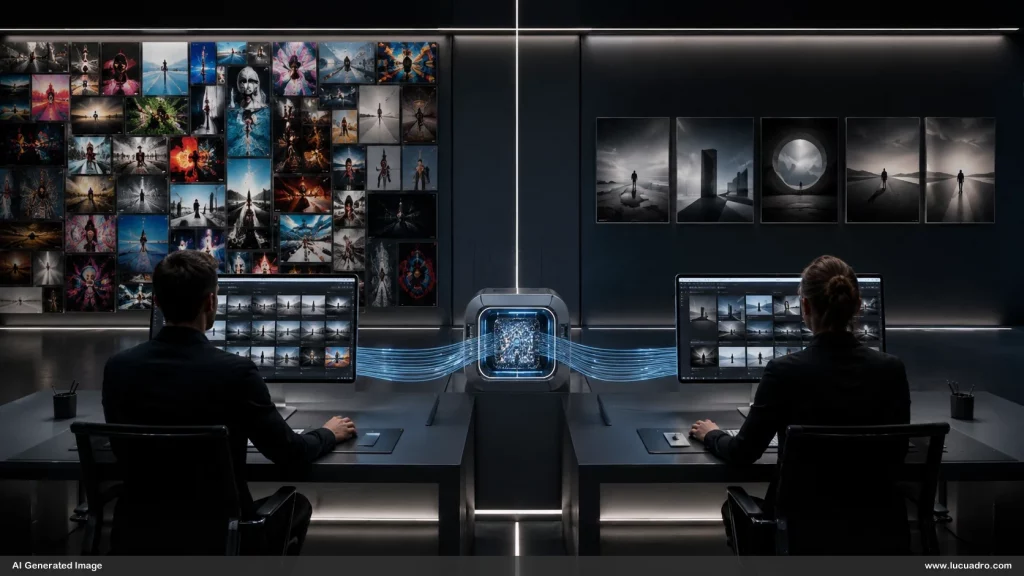
Taste tells you:
- which option feels alive
- which detail weakens the composition
- which visual choice feels outdated
- which image contains too many competing ideas
- which concept is visually impressive but strategically empty
- which imperfection makes an image more believable
- which style has become overused
- which reference contains something worth developing
- which visual should be rejected even though it took hours to create
Taste is a filtering system.
And when machines can produce infinite material, filtering becomes central.
Imagine two marketers using the same AI image model.
They have access to the same tools.
They use similar prompts.
They generate the same number of images.
One produces work that feels generic, inconsistent, and forgettable.
The other produces work that feels intentional, distinctive, and emotionally precise.
The difference is not access.
The difference is judgment.
One person sees an output and thinks, “That looks good.”
The other asks, “Good for what?”
That question is the foundation of art direction.
Selection Is a Creative Act
Generative AI has made one creative skill newly important: selection.
Selecting an image is often treated as the final administrative step after creation.
It should be understood as part of creation itself.
Editors know this.
Curators know this.
Photographers know this.
Filmmakers know this.
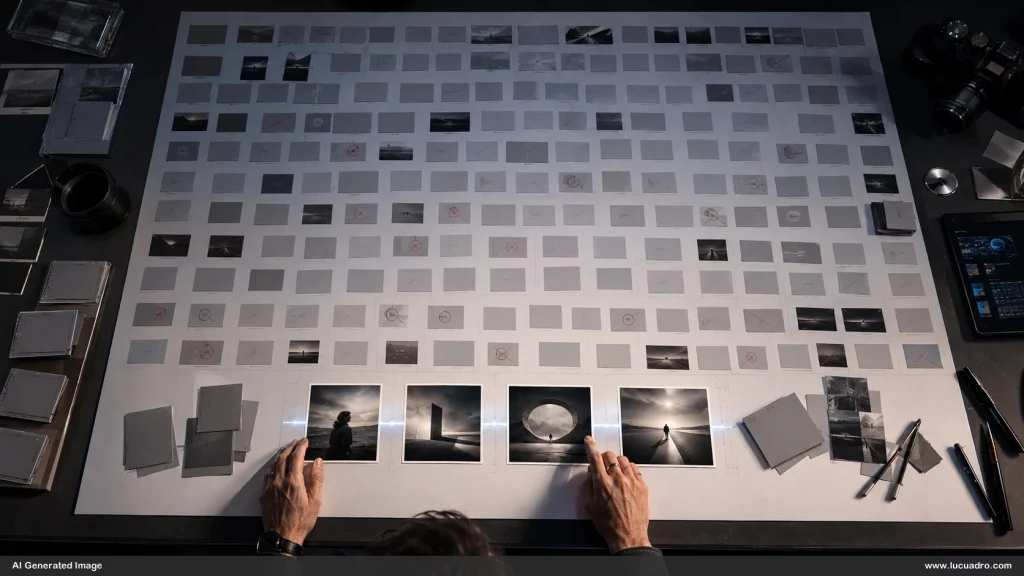
The meaning of a body of work is shaped not only by what is produced, but by what is excluded.
An AI model may generate a hundred images.
The selected five become the campaign.
The other ninety-five disappear.
Selection determines the public result.
This means that the person choosing the images is not merely reviewing the work.
They are authoring the final experience.
A weak selection process usually favors obvious signals:
The sharpest image.
The most dramatic image.
The image with the highest visual complexity.
The image that looks expensive.
The image that attracts attention immediately.
But the most attention-grabbing image is not always the strongest image.
It may overpower the message.
It may contradict the brand.
It may look impressive in isolation but fail as part of a sequence.
It may contain visual clichés that reduce trust.
It may resemble dozens of competitor campaigns.
It may win the first second and lose the next ten.
Strong selection considers the role of the image.
Sometimes the right image is quieter.
Sometimes it contains more negative space.
Sometimes it supports typography instead of competing with it.
Sometimes it feels less polished and more human.
Sometimes it creates tension rather than instant gratification.
Sometimes it becomes powerful only when placed beside another image.
This is why visual judgment cannot be reduced to “pick the best-looking output.”
There is no universally best image.
There is only the image that best serves the intention.
Sequencing Creates Meaning
An individual image can attract attention.
A sequence of images can shape perception.
This is one of the most overlooked dimensions of AI art direction.
Generative tools encourage isolated production.
You create one image, then another, then another.
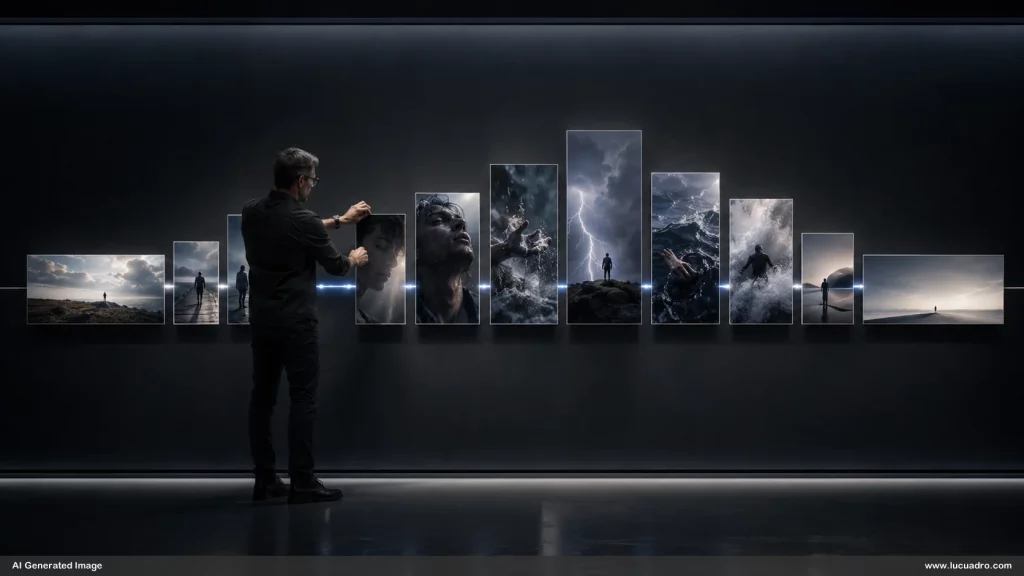
But brands, campaigns, presentations, websites, and stories are rarely experienced as isolated frames.
They are experienced as sequences.
A viewer sees the hero image.
Then the product visual.
Then the proof section.
Then the customer story.
Then the call to action.
A presentation moves from title slide to problem, tension, insight, solution, and conclusion.
A social campaign unfolds across several posts.
A product launch develops over several weeks.
The visual meaning changes depending on the order.
A dramatic image placed first may create curiosity.
The same image placed later may feel like evidence.
A close-up may create intimacy after a wide establishing shot.
A minimalist visual may create relief after a dense information section.
A repeated visual motif may establish recognition across several pieces of content.
Sequencing controls rhythm.
It manages visual intensity.
It determines when to reveal and when to withhold.
It creates contrast.
It tells the viewer how separate images belong together.
AI can generate every frame.
But it does not automatically understand the emotional arc between them.
That is the art director’s role.
The art director does not merely ask, “Is this image good?”
They ask:
What comes before it?
What comes after it?
What visual expectation has already been created?
Does this image continue the rhythm or break it intentionally?
Are we repeating ourselves?
Are we escalating?
Are we becoming clearer?
Is the viewer being guided or merely shown more content?
In an age of visual abundance, sequencing may become one of the most valuable creative capabilities.
The future belongs not only to people who can generate beautiful images, but to people who can arrange those images into a meaningful experience.
More Images Can Create Less Meaning
Generative AI encourages volume.
More concepts.
More versions.
More styles.
More content.
More experimentation.
This is useful during exploration.
It becomes dangerous when volume is mistaken for value.
Visual abundance can create visual numbness.
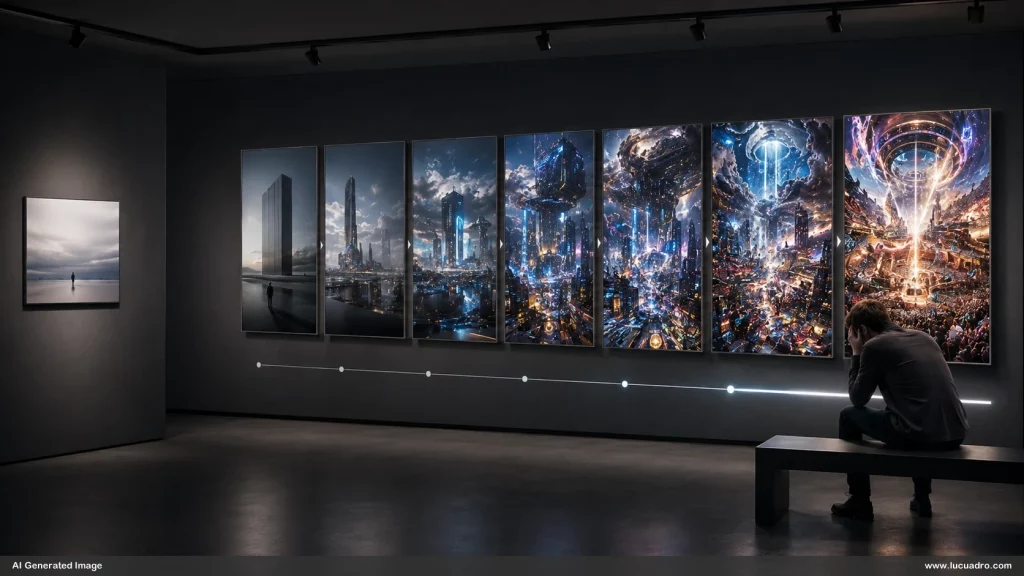
When every image is dramatic, nothing feels dramatic.
When every campaign contains glowing objects, cinematic lighting, impossible architecture, and hyperreal surfaces, these effects stop communicating innovation.
They become background noise.
This is already happening.
Certain AI aesthetics are becoming instantly recognizable:
Perfectly centered compositions.
Extreme depth of field.
Glowing neon accents.
Reflective futuristic materials.
Overly smooth faces.
Tiny figures standing inside enormous environments.
Floating product displays.
Artificially dramatic cloud formations.
Surreal objects placed in pristine landscapes.
These images can still be effective.
But they are no longer automatically distinctive.
Their novelty is declining.
The problem is not that AI has a style.
The problem is that people often accept the first style AI gives them.
Art direction resists default aesthetics.
It asks whether the image is expressing the brand or merely exposing the tool.
This distinction will become increasingly important.
In the early stages of generative AI, audiences may reward images simply because they look technically impressive.
Later, technical impressiveness becomes normal.
When everyone can produce spectacle, spectacle stops being a strategy.
The value shifts toward specificity.
A specific point of view.
A specific emotional tone.
A specific visual system.
A specific understanding of the audience.
A specific relationship between the image and the message.
The future of AI-generated imagery is not endless visual excess.
It is better-directed visual restraint.
Brand Consistency Becomes Harder, Not Easier
AI image generation appears to solve one of the central challenges of visual branding: creating enough content.
It does.
But it also creates a new challenge: maintaining coherence across that content.
A brand can now generate hundreds of images, but those images may differ in:
- lighting
- color temperature
- camera perspective
- character appearance
- materials
- environments
- emotional tone
- composition
- realism
- visual density
- symbolic language
Each individual image may look acceptable.
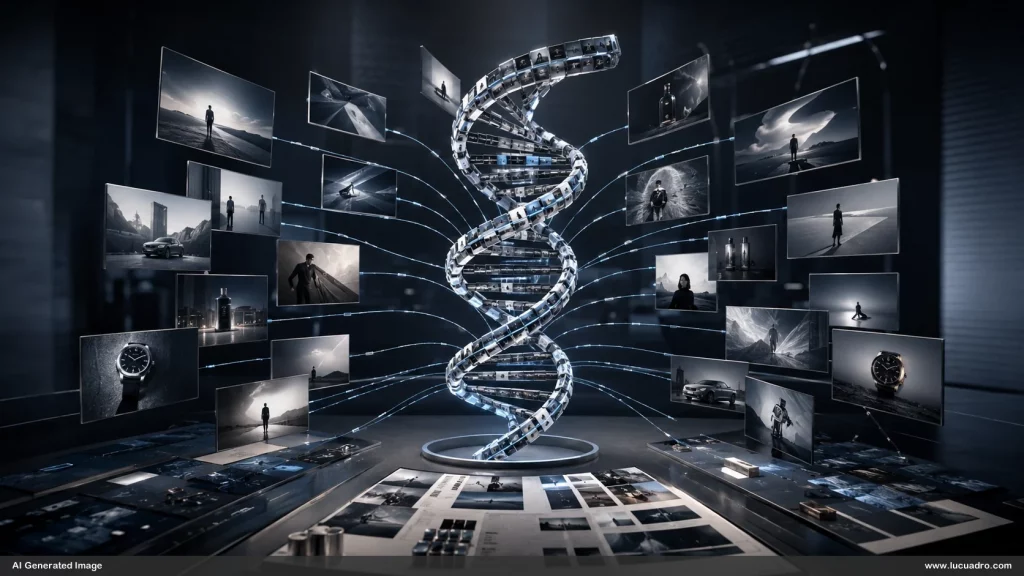
Together, they may look like they came from twenty different companies.
This is the difference between visual content and a visual system.
A visual system creates rules.
It defines what remains consistent and what may vary.
It might establish:
A preferred camera distance.
A recognizable lighting logic.
A specific balance between realism and abstraction.
A recurring material palette.
A limited color environment.
A characteristic use of space.
A repeatable way of framing people.
A consistent level of visual intensity.
A distinct relationship between subject and background.
A library of approved references.
Without these rules, AI generation produces fragmentation.
The brand becomes visually unstable.
This is why the rise of generative AI will increase demand for stronger creative direction, not eliminate it.
Brands will need people who can convert vague identity language into visible constraints.
“Modern” is not a system.
“Premium” is not a system.
“Human” is not a system.
“Innovative” is not a system.
These words are too broad.
Art direction turns them into decisions.
What does premium lighting look like for this brand?
How much visual complexity is allowed?
Should people look directly at the camera?
Should environments feel real or slightly idealized?
Should surfaces be tactile, polished, imperfect, industrial, organic, soft, or technical?
How much symmetry should be used?
How much color?
How much emptiness?
How much movement?
AI can help generate the answers visually.
But humans must decide which answers belong to the brand.
Visual References Become Strategic Assets
Text prompts are important.
Visual references are often more important.
A phrase such as “cinematic, premium, modern, sophisticated” can be interpreted in thousands of ways.
A reference image can immediately communicate composition, lighting, texture, atmosphere, scale, and spatial relationships.
This is why AI-ready visual asset libraries will become central to creative production.
The most valuable visual assets will not always be finished images designed for direct publication.
They may be starting points:
Composition references.
Lighting references.
Pose references.
Material references.
Layout systems.
Scene structures.
Product placement templates.
Character sheets.
Environment collections.
Camera-angle libraries.
Moodboards.
Color systems.
Visual sequences.
Brand-specific example sets.
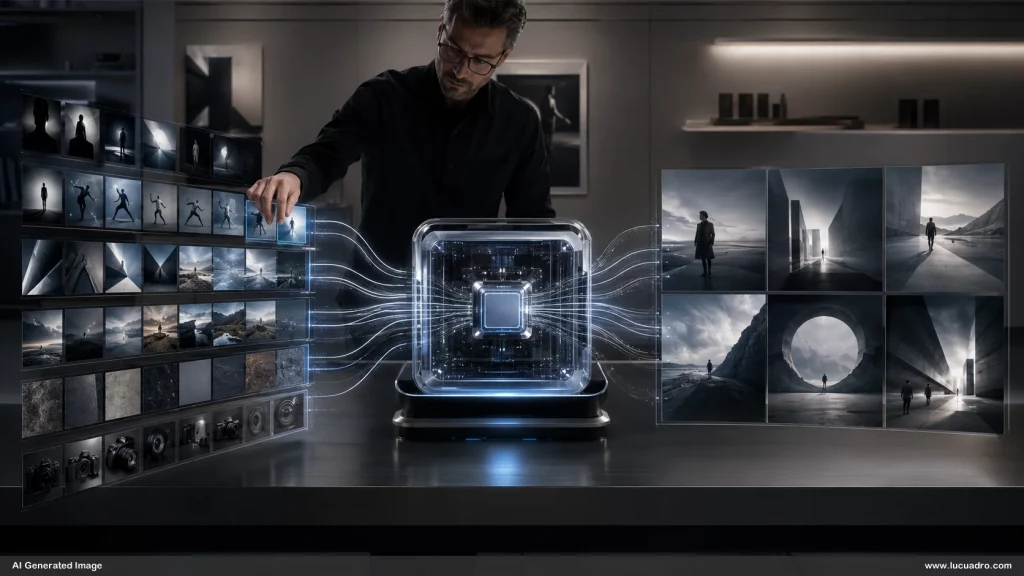
These assets reduce ambiguity.
They give generation models clearer direction.
More importantly, they help humans think.
A strong reference does not merely tell the AI what to generate.
It helps the creative team discover what it wants.
This makes visual reference selection a form of strategy.
Which references are chosen?
Which are rejected?
Which elements are borrowed?
Which elements must never appear?
Which references are combined?
Which visual principles are extracted?
This is where visual asset stores can move beyond the traditional stock-media model.
The old model sells finished assets.
The new model can provide systems for directing generation.
Instead of buying one image, a user gains a reusable visual logic.
Instead of downloading a fixed composition, the user accesses a structure that can produce dozens of variations.
Instead of purchasing decoration, the user purchases direction.
Prompt Engineering Is Becoming Art-Direction Engineering
Prompt engineering initially focused on language.
Add more detail.
Specify the camera.
Name the lighting.
Describe the materials.
Include the style.
Set the aspect ratio.
This remains useful.
But the next stage is broader.
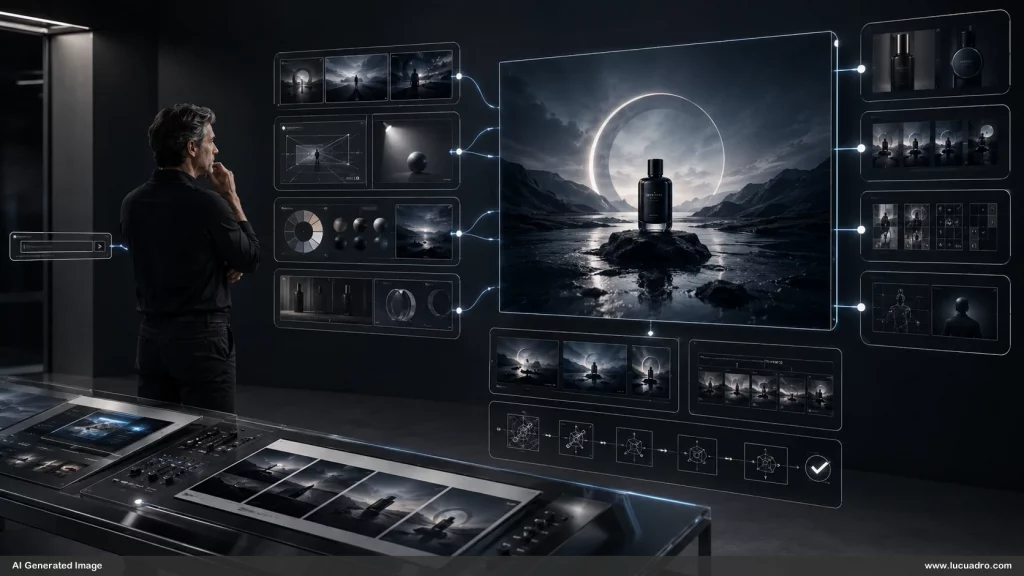
The best AI image workflows will combine:
- verbal instructions
- visual references
- composition control
- iterative selection
- image editing
- brand constraints
- asset libraries
- variation rules
- sequencing
- human review
This is not simply prompt engineering.
It is art-direction engineering.
The goal is not to produce one attractive output.
The goal is to create a reliable system that repeatedly produces suitable outputs.
That requires thinking in layers.
Strategic layer
What is the communication goal?
What should the audience think, feel, or do?
Conceptual layer
What visual metaphor or idea expresses that goal?
Aesthetic layer
What should the image feel like?
Structural layer
How should the visual elements be arranged?
Technical layer
What model, prompt, reference, control method, or editing workflow should be used?
Editorial layer
Which outputs survive selection?
System layer
How do the chosen images remain coherent across the full campaign?
Most weak AI image workflows begin at the technical layer.
They ask which prompt words produce a beautiful result.
Strong workflows begin at the strategic layer.
They ask what the image must accomplish.
The difference is profound.
The Creative Advantage Moves Upstream
When execution becomes easier, competitive advantage moves upstream.
Consider what happened with website building.
At one time, simply knowing how to create a functioning website was valuable.
As templates and website builders improved, basic execution became easier.
The advantage moved toward positioning, conversion strategy, user experience, brand differentiation, and content.
The same shift is happening with AI imagery.
The ability to generate an image will not remain a meaningful differentiator.
Nearly everyone will be able to do it.
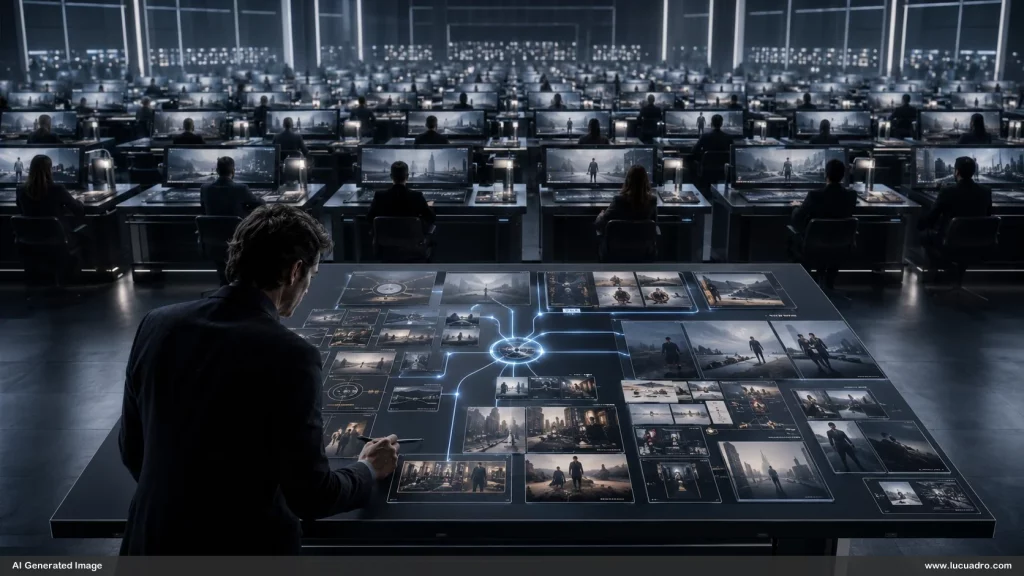
The advantage will move toward:
- identifying stronger visual ideas
- understanding audience psychology
- creating recognizable visual systems
- choosing better references
- rejecting generic outputs
- integrating images with copy
- building campaign-level coherence
- developing distinctive visual taste
- directing attention deliberately
- creating emotional sequences
These capabilities are upstream from production.
They shape what should be produced before production begins.
This is good news for creative professionals who understand their real value.
The designer’s value was never merely knowing where to click.
The photographer’s value was never merely owning a camera.
The illustrator’s value was never merely making marks.
The art director’s value was never merely requesting visual assets.
The value lies in perception.
Knowing what the work needs.
Seeing what is missing.
Recognizing what is false.
Understanding what the viewer will notice.
Sensing when a concept has become overworked.
Knowing when an image is technically successful but emotionally dead.
These capabilities do not become less important when production accelerates.
They become the control system for that acceleration.
Human Judgment Is Not a Luxury Layer
Some organizations will treat human review as an optional finishing step.
Generate at scale.
Automate publication.
Add human judgment only to high-value projects.
This approach will produce a large amount of content.
It may not produce much value.
Human judgment should not be treated as a luxury layer added after generation.
It should shape the system from the beginning.
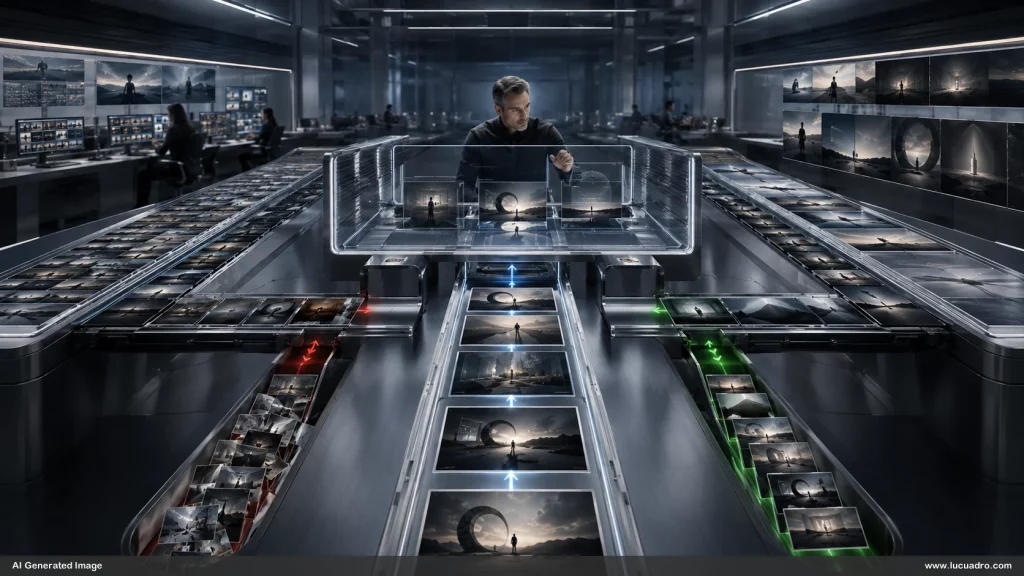
Without judgment, automated production tends toward averages.
Models are trained on existing visual culture.
They are extraordinarily powerful pattern synthesizers.
But the safest output is often the most statistically familiar output.
Familiarity can be useful.
It can also create generic work.
Distinctive visual communication often requires intentional deviation.
A strange crop.
An unexpected pause.
An uncomfortable amount of empty space.
A color choice that resists category convention.
A deliberately ordinary setting.
A visual metaphor that is not immediately obvious.
A sequence that reveals information slowly.
An image that feels almost incomplete without the headline.
These decisions can appear inefficient to a system optimized for obvious visual appeal.
But they may be exactly what creates memorability.
Human judgment introduces purpose into variation.
It can decide not to maximize everything.
Not maximum drama.
Not maximum realism.
Not maximum detail.
Not maximum beauty.
Not maximum visual stimulation.
Art direction often means choosing what not to maximize.
The Most Important Question Is No Longer “Can We Make It?”
For much of creative production, the first question was practical:
Can we make this?
Do we have the budget?
Do we have the skill?
Do we have the equipment?
Do we have the time?
Generative AI changes the answer.
In many cases, yes.
We can make it.
We can make several versions.
We can make them now.
The more important questions become:
Should we make it?
Why should it look this way?
What does it add?
What does it replace?
Does it make the message clearer?
Does it strengthen recognition?
Does it create trust?
Does it express something specific?
Will anyone remember it?
These questions sound simple.
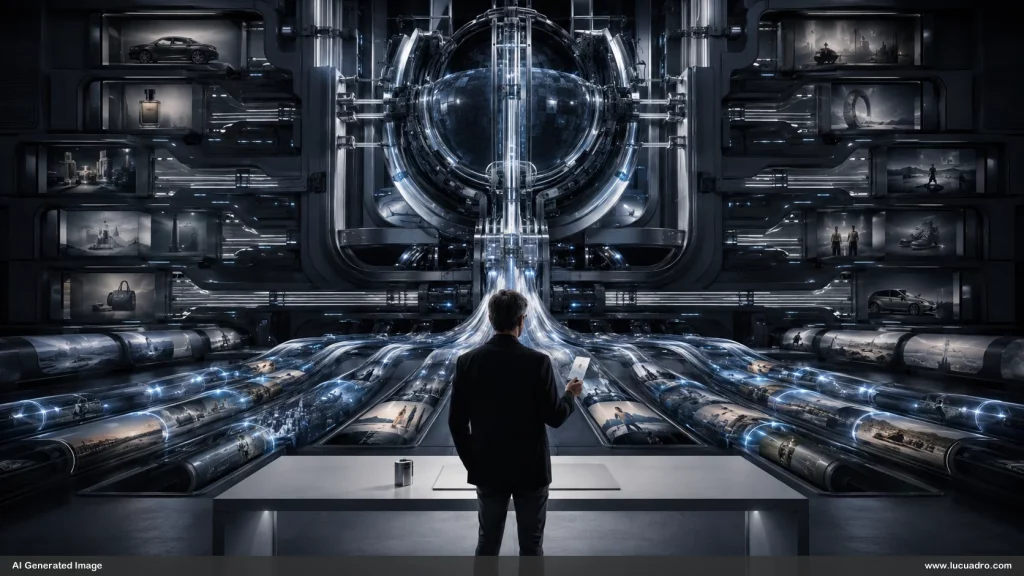
They are difficult because they cannot be solved by generating more options.
More output does not automatically create more clarity.
At some point, the creative process must move from expansion to reduction.
From possibility to decision.
From “what else can we make?” to “what deserves to remain?”
This transition is where art direction becomes most valuable.
Art Directors Become Designers of Possibility Spaces
The role of the art director is also changing.
Traditionally, art directors coordinated photographers, illustrators, designers, stylists, retouchers, set builders, and other specialists.
Those roles will continue.
But art directors will increasingly direct systems as well as people.
They will shape the possibility space from which AI outputs emerge.
They may define:
Approved styles.
Excluded aesthetics.
Reference libraries.
Composition families.
Lighting boundaries.
Character rules.
Acceptable levels of realism.
Variation ranges.
Brand-specific prompt structures.
Review criteria.
Image-quality standards.
Campaign sequencing.
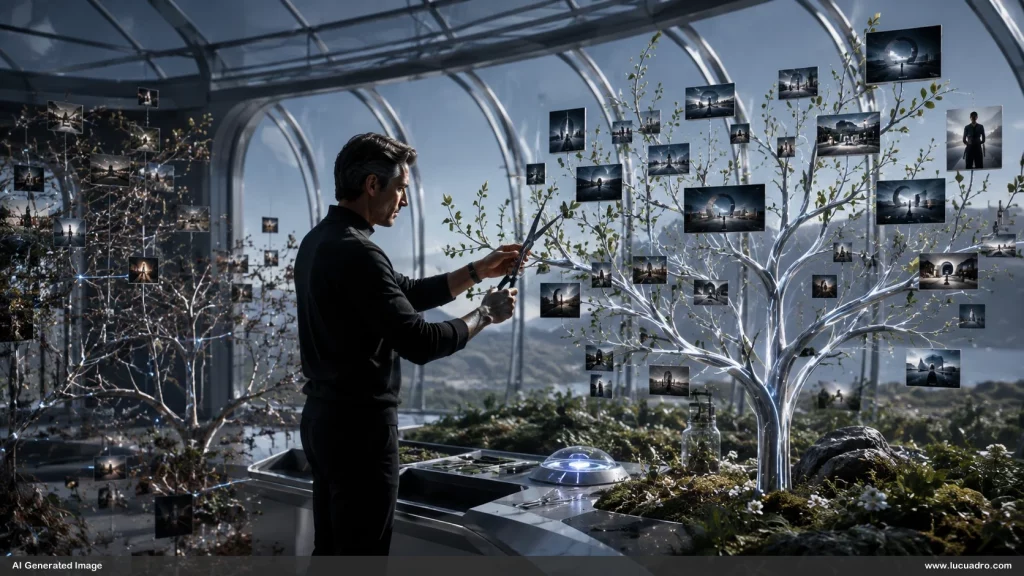
They will not need to control every pixel manually.
They will control the environment in which visual decisions are made.
This is a more strategic role.
It resembles gardening more than assembly.
Create the conditions.
Set the boundaries.
Introduce the right inputs.
Remove weak growth.
Encourage useful variation.
Protect the identity of the system.
The art director of the AI era is not merely a person who gives instructions.
They are a designer of visual possibility.
Taste Can Be Developed
The growing importance of taste may sound discouraging.
Taste can appear mysterious.
But taste is trainable.
It develops through exposure, comparison, analysis, and deliberate practice.
The fastest way to improve visual judgment is not to generate more images blindly.
It is to review images more consciously.
Instead of asking whether an image looks good, ask why.
What creates the hierarchy?
Where does the eye move first?
How is depth established?
How much information is present?
What is the relationship between subject and background?
What is the emotional temperature?
What makes the image feel expensive, intimate, cold, trustworthy, urgent, or calm?
What could be removed?
What feels familiar?
What feels specific?
How does the image support the message?
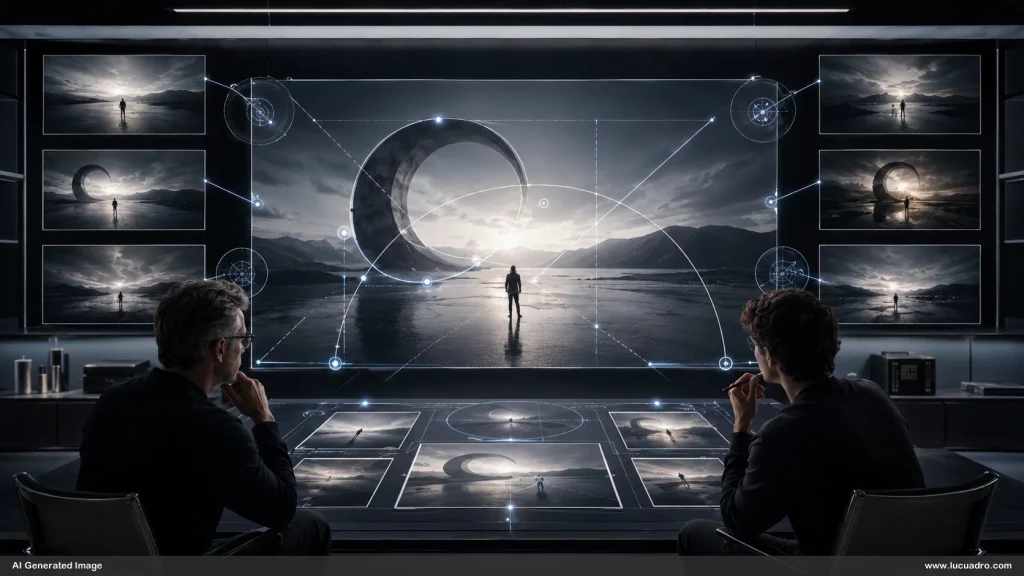
Comparison is especially powerful.
Place five outputs beside one another.
Do not choose immediately.
Identify the strengths and weaknesses of each.
One may have stronger lighting.
Another may have a better pose.
Another may contain more useful negative space.
Another may be more distinctive but less brand-appropriate.
This trains the eye to separate qualities that are often collapsed into the vague word “good.”
Taste also develops through collecting.
Build reference libraries.
Save compositions, not only styles.
Save examples of pacing, hierarchy, framing, transitions, materials, color relationships, and emotional tone.
Organize them by what they do.
Not merely “beautiful images.”
But:
Images that create authority.
Images that create intimacy.
Images that make a product feel tactile.
Images that create mystery without becoming unclear.
Images that use scale effectively.
Images that support headlines.
Images that make technical subjects feel human.
A well-built reference library becomes an externalized form of taste.
It helps creative teams move beyond random inspiration toward repeatable visual thinking.
The Brands That Win Will Generate Less Randomly
The promise of AI is often expressed as scale.
More content.
More variations.
More personalization.
More speed.
But the brands that benefit most will not be the ones that generate the most.
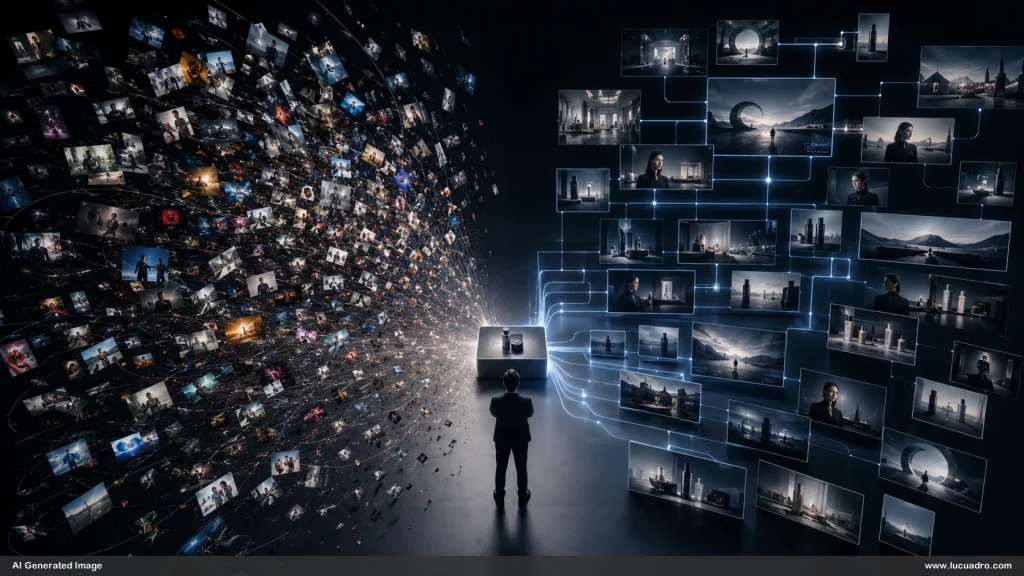
They will be the ones that generate with the strongest internal logic.
They will know what their imagery is for.
They will know how it should feel.
They will know which visual patterns belong to them.
They will know when to use consistency and when to introduce surprise.
They will treat visual assets as part of their strategic infrastructure.
They will build systems that help teams create without losing identity.
They will not ask AI to invent the brand from scratch every time.
They will provide it with a visual world.
This world may include characters, environments, compositions, materials, lighting, symbols, and narrative structures.
Each campaign can vary.
The underlying visual intelligence remains recognizable.
That is how AI image generation becomes a brand advantage rather than a content machine.
The Future Is Not Human Versus AI
The most productive framing is not human creativity versus artificial intelligence.
It is human direction multiplied by machine production.
AI expands the number of things a creative person can test.
It makes experimentation cheaper.
It makes iteration faster.
It allows small teams to explore visual territory once reserved for large budgets.
It gives art directors more material to shape.
It gives brands more opportunities to develop distinctive visual systems.
But multiplication only helps when the thing being multiplied is valuable.
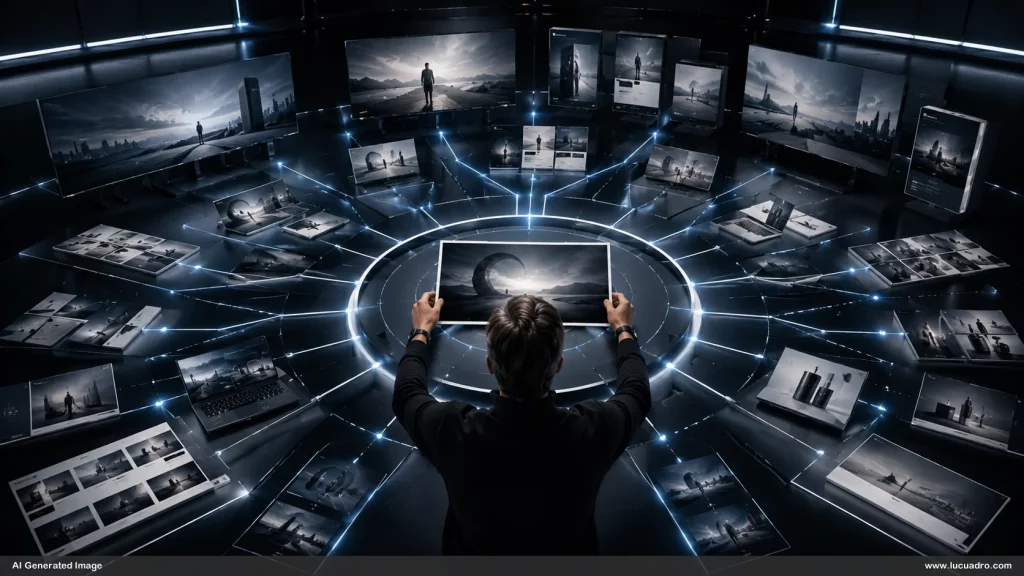
AI multiplies weak ideas too.
It multiplies clichés.
It multiplies inconsistency.
It multiplies poor taste.
It multiplies visual noise.
The model does not decide whether the underlying direction is strong.
It amplifies the direction it receives.
This is why the human role does not disappear.
It becomes more consequential.
A poor visual decision can now be reproduced across a thousand assets.
A strong visual idea can also be expanded across a complete campaign, multiple markets, and dozens of formats.
AI increases the leverage of judgment.
That leverage works in both directions.
Art Direction Becomes the Bottleneck—and the Opportunity
Every technological shift removes one bottleneck and reveals another.
Generative AI removes much of the production bottleneck.
The next bottleneck is discernment.
Can the team recognize the best concept?
Can it maintain coherence?
Can it avoid default aesthetics?
Can it connect visuals to strategy?
Can it build a sequence rather than a pile?
Can it distinguish novelty from meaning?
Can it stop generating when the work is already strong?
These questions define the next creative advantage.
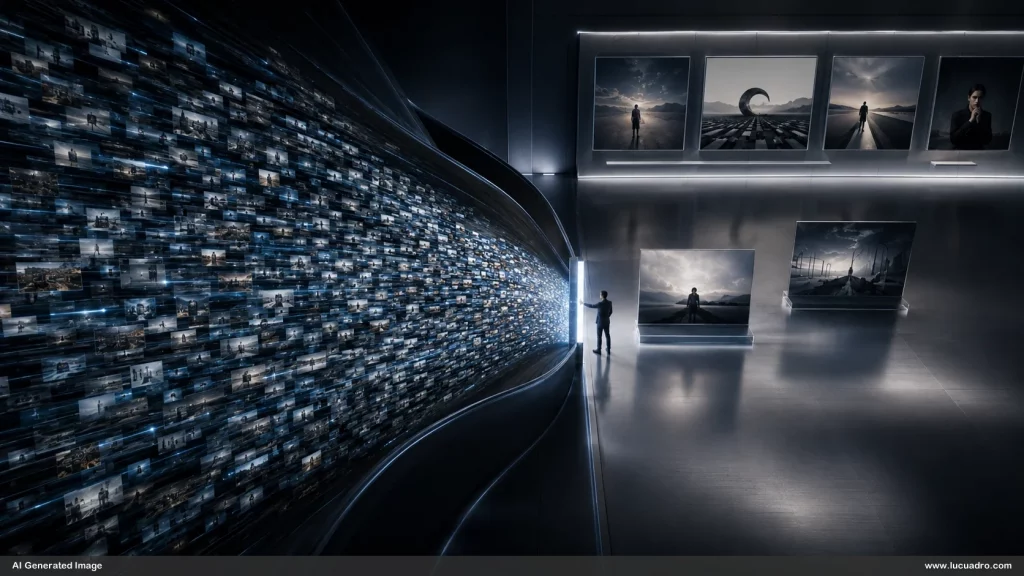
The future will contain more images than any previous generation could imagine.
Most will be ignored.
Some will be attractive.
A smaller number will be coherent.
Fewer will feel distinctive.
Very few will create a lasting emotional or strategic effect.
The difference will not be access to the model.
Access will become common.
The difference will be the quality of direction.
The ability to see.
The ability to choose.
The ability to arrange.
The ability to reject.
The ability to know what the image is meant to do.
That is art direction.
And it is becoming more valuable precisely because image production is becoming easier.
Conclusion: Unlimited Production Makes Judgment Priceless
AI image generation changes the economics of visual creation.
It reduces cost.
It increases speed.
It expands creative possibility.
It enables individuals and small teams to produce work at a scale that once required entire departments.
But it does not remove the need for human visual intelligence.
It intensifies it.
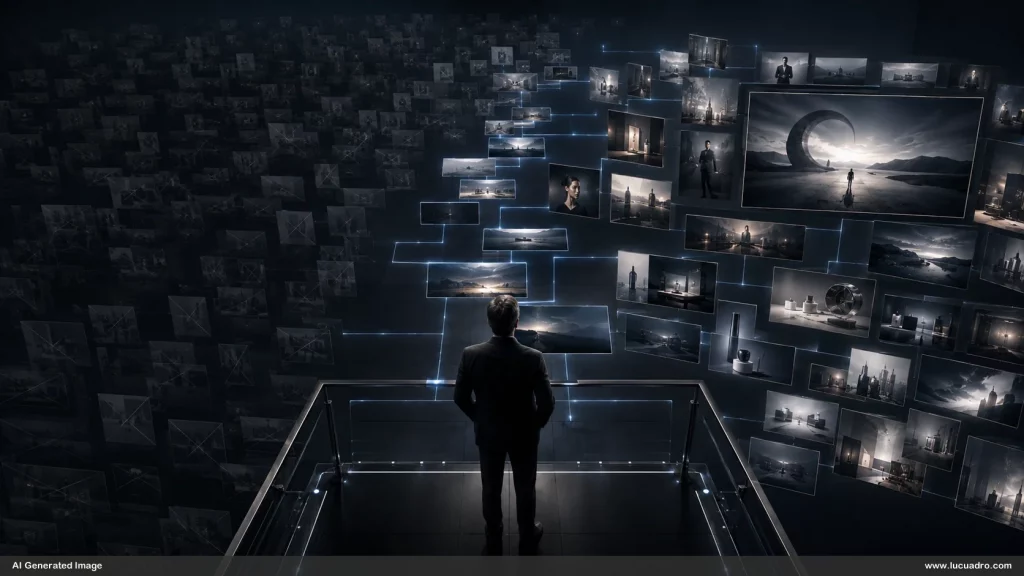
When production is scarce, the ability to make is valuable.
When production is abundant, the ability to decide becomes valuable.
Human taste becomes the filter.
Selection becomes authorship.
Sequencing becomes storytelling.
Restraint becomes differentiation.
Visual systems become strategic assets.
Art direction becomes the discipline that turns infinite possibility into a coherent result.
The next generation of creative leaders will not compete by generating the most images.
They will compete by creating the clearest visual worlds.
They will know which possibilities to pursue.
They will know which outputs to discard.
They will know how to connect imagery to identity, emotion, narrative, and purpose.
AI does not make art direction obsolete.
It makes art direction visible.
It reveals that producing an image was never the whole job.
The real work was always deciding what the image should mean.
And in an age of nearly unlimited image production, that decision becomes priceless.