
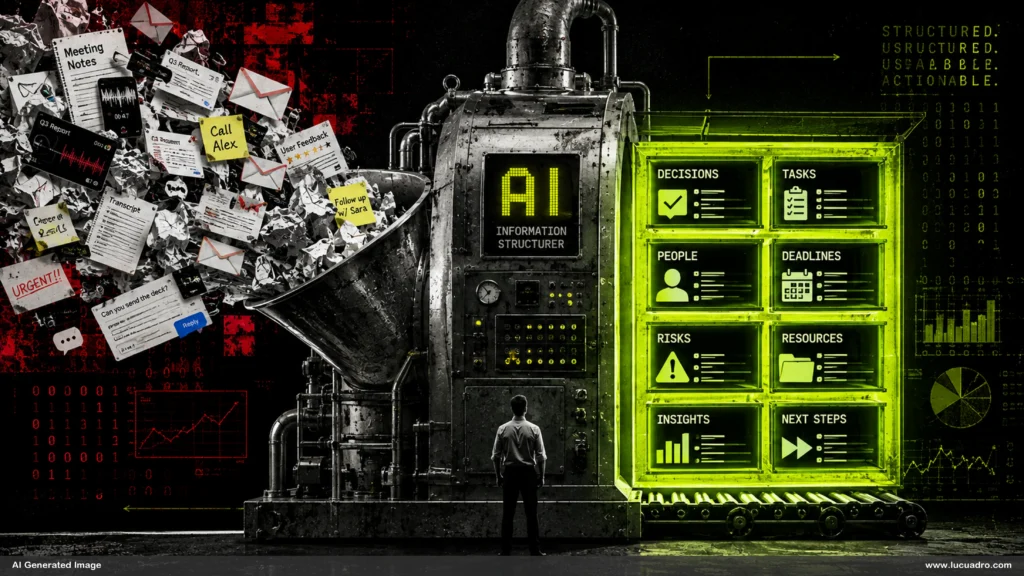
How AI can turn unstructured information into useful structure is one of the most practical ways to understand what generative systems are actually good at. Most real work does not begin with a perfect spreadsheet or a clean database. It begins with meeting notes, transcripts, emails, research fragments, screenshots, comments, briefs, and mixed documents. AI is especially useful when the information already exists but its structure is hidden, inconsistent, or difficult to work with.
Unstructured information is not the same as useless information
A long transcript can contain decisions, objections, deadlines, repeated concerns, and unresolved questions even if none of them are labeled. Customer feedback can reveal clear themes despite arriving as hundreds of unrelated comments. A research folder can contain useful evidence without any consistent naming system. The information has value, but the relationships inside it are not yet easy to see.
AI can help because it is good at recognizing recurring patterns across language and examples. It can group similar ideas, identify repeated topics, separate actions from background context, distinguish examples from instructions, and infer a useful hierarchy from material that initially looks chaotic. The important point is that the structure is often already latent in the source. AI helps expose it.
AI can convert one information shape into another
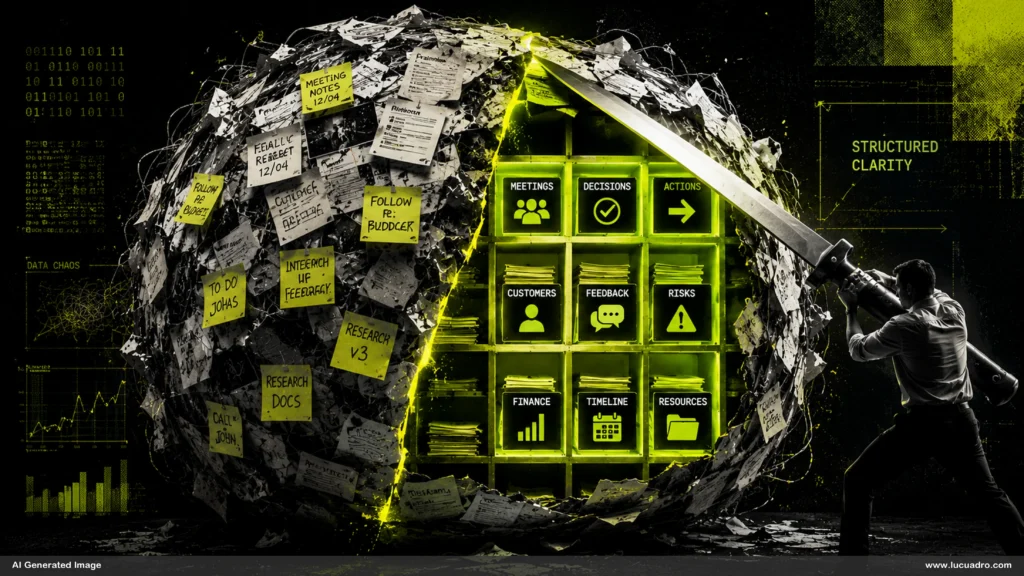
Once patterns are visible, the same material can be reformatted for a different purpose. Notes can become an outline. Interview transcripts can become themes and quotations. Research can become a comparison matrix. A long document can become key points, risks, decisions, and next actions. A collection of visual references can become a defined art direction with recurring composition, palette, framing, and lighting characteristics.
This conversion ability matters because much of knowledge work is really format work. The information may already exist, but it is trapped in a form that is inconvenient for the next step. AI acts as a translation layer between raw material and a more usable representation. The more clearly you define the destination, the easier it becomes to judge whether the transformation succeeded.
Extraction is different from summarization
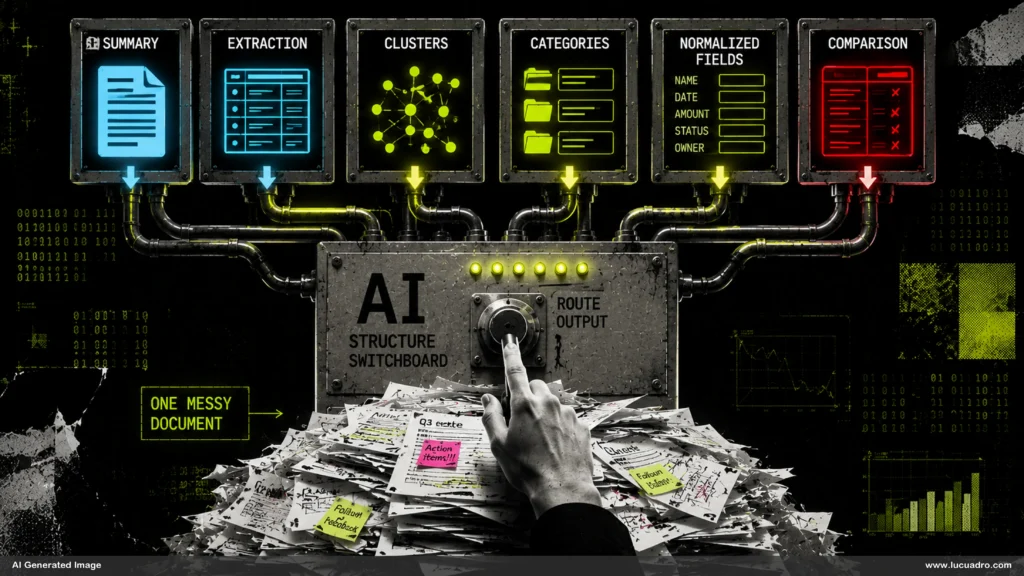
People often group all of this under summarization, but several distinct operations are happening. Summarization compresses material. Extraction pulls out specific information. Classification assigns items to categories. Clustering groups similar items without requiring fixed categories in advance. Normalization turns inconsistent formats into a common structure. Comparison identifies similarities and differences across sources. These are related tasks, but each produces a different kind of useful structure.
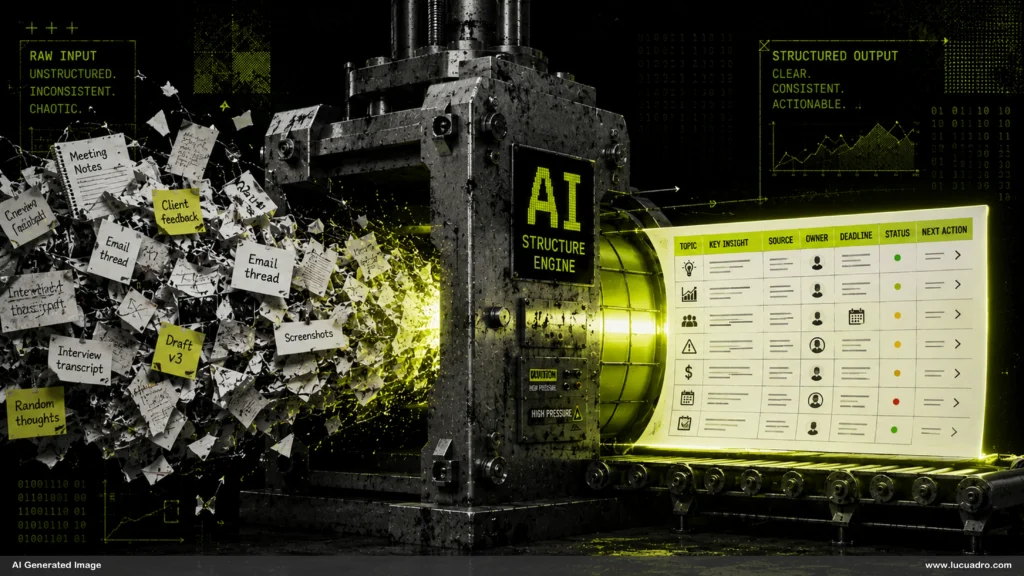
That distinction matters when you design the prompt. Asking AI to “summarize these notes” may produce a readable paragraph but hide the details you actually need. Asking for decisions, owners, deadlines, unresolved questions, and risks produces a structure that is easier to use operationally. Good AI use often begins by deciding what shape the output should have before asking the model to process the material.
It also helps to think in schemas rather than summaries. A schema is simply the structure you want the information to fit into: issue, evidence, owner, deadline, status, for example. Once that destination is explicit, AI can map messy inputs into repeatable fields instead of producing free-form prose. This is especially useful when you need to process many similar documents or notes consistently. The model still needs review, but the output becomes easier to scan, compare, and reuse because the structure is defined before generation begins.
Structured outputs make large information sets easier to inspect
Organization does more than save time. It changes what you can see. One hundred isolated comments are cognitively expensive to compare. Group them by recurring issue, frequency, sentiment, or customer type and patterns become obvious. A dozen reference images may simply feel similar until their shared framing, negative space, color treatment, subject position, and lighting are described systematically.
This is closely related to why AI is good at pattern recognition. The model can work across many examples at once and produce a compressed representation of what repeats. That representation is not automatically perfect, but it gives you a much more manageable surface for review than the raw material alone.
Source-grounded restructuring is easier to verify than open-ended generation
There is another reason this use case is so strong. When AI reorganizes material you supplied, you can compare the result with the source. You can check whether a theme was overstated, whether an important exception disappeared, or whether two categories should be merged. The output remains tethered to evidence you already possess.
This is different from asking the model to invent facts, identify an unknown current event, or make a claim about the external world without sources. In those cases, plausibility can be mistaken for truth. With bounded restructuring, the verification problem is much smaller because you can trace important claims back to the original material. That is why using AI to summarize and structure information is such a dependable everyday application.
The best workflow preserves both the structure and the source
Useful structure should make the source easier to work with, not erase it. Keep original documents available. Ask for categories that cite or point back to the underlying material when accuracy matters. Separate direct extraction from interpretation. If a conclusion depends on several pieces of evidence, make that relationship visible instead of allowing the final summary to flatten everything into one confident statement.
Understanding how AI can turn unstructured information into useful structure changes the role you give it. Instead of treating AI mainly as a machine that generates answers, you can use it as an organizer, classifier, transformer, and comparison engine.