

How to Build an AI Image Library You Can Reuse Across Campaigns is really a question about whether your image generation process produces assets or merely outputs. A folder full of attractive images can still force you to begin every campaign from zero. The more useful goal is a reusable visual system: themed visual asset sets for niche marketing campaigns, layered design assets you can combine into your own compositions, and a consistent visual system for a brand.
A Reusable AI Image Library Starts With Campaign Roles, Not Individual Prompts
The first mistake is treating the prompt as the unit of production. A prompt is temporary. A campaign role is reusable. Before generating anything, define what kinds of images repeatedly appear in your work: hero visuals, section backgrounds, product frames, character scenes, close details, comparison views, and empty compositions with room for copy. Once those roles are visible, image generation stops being an open ended search for something good and becomes a controlled effort to fill known visual jobs.

Campaign roles also prevent overproduction. Without them, it is easy to generate fifty variations of the same attractive scene because each one feels potentially useful. In practice, the tenth hero image often adds less value than the first clean background, the first usable close up, or the first alternate orientation. A reusable library grows by coverage. Each new asset should fill a gap in the system, support a new placement, or provide a controlled variation that can replace an existing component without breaking the overall visual language.
This is where a simple campaign map becomes more useful than a long prompt collection. Start with the outputs you routinely need and trace backward to the image roles that feed them. A launch page may need a wide hero, two supporting scenes, a square social crop, and several transparent objects. A course campaign may need a presenter, lesson backgrounds, thumbnails, and announcement visuals. The important move is to define recurring demand first, then generate toward it. That turns the library into production infrastructure rather than visual leftovers.
The same logic helps you judge whether an image belongs in the library. A beautiful generation that solves no recurring role may still be worth keeping, but it should not dictate the system. A modest image that repeatedly supports titles, overlays, crops, and alternate compositions can be far more valuable. Reuse depends on functional fit. The strongest libraries are built around what the work repeatedly requires, not around whichever outputs happened to look impressive during a generation session.
You can make this concrete by assigning every planned image a role before generation begins. The role can be broad enough to support variation but specific enough to explain why the asset exists. “Wide campaign opener with right side negative space” is more useful than “office scene.” “Transparent product supporting object” is more useful than “computer.” The role describes how the image will be used, which helps you judge composition, crop tolerance, and whether a variation adds meaningful coverage.
This role first method also improves prompting because the prompt inherits a compositional purpose. Instead of asking the model to make an attractive image and deciding afterward where it might fit, you can specify the space the final design needs, the viewing angle that supports that space, and the elements that should remain unobstructed. The generated image is evaluated against a job. That gives you a clearer acceptance standard and reduces the temptation to keep visually interesting outputs that never become useful assets.
A Consistent Visual System Matters More Than One Perfect AI Image
Consistency is what allows separate images to feel like parts of one system. That does not mean every image should share the same composition. It means the family carries recognizable decisions across changing scenes: similar light behavior, compatible contrast, a related palette, recurring material qualities, and a stable level of realism or illustration. When those decisions drift too far, every new campaign requires extra correction work because the assets resist being placed beside one another.
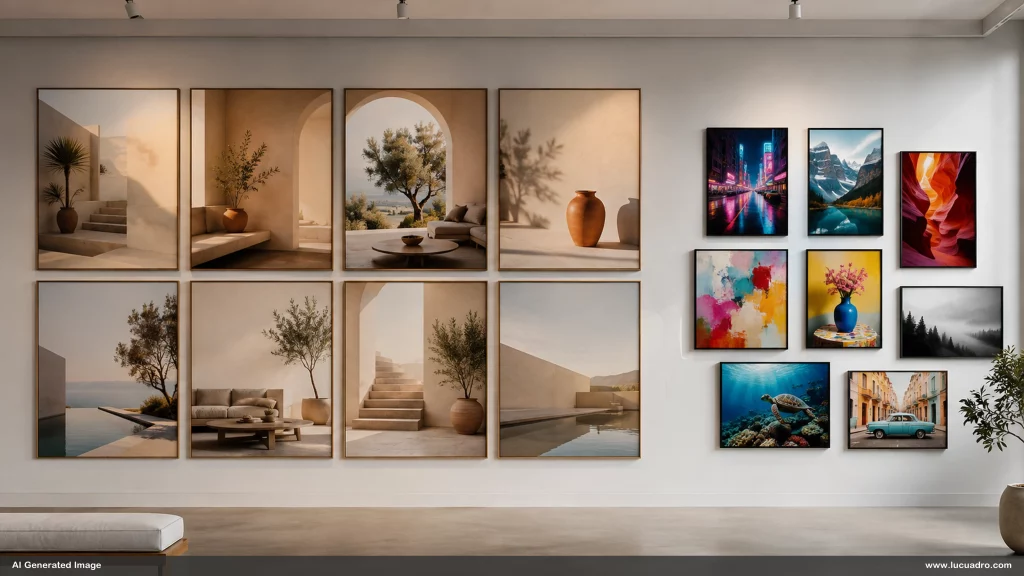
A consistent visual system matters most when the library is used over time. One campaign may tolerate five unrelated images if each one is strong by itself. The next campaign exposes the problem. Reusing two of those images beside three newly generated ones can make the whole set feel assembled from different sources. The cost appears later as color correction, replacement, cropping, or complete regeneration. Consistency reduces that future cost because new work can enter an existing visual family instead of creating a new family by accident.
The practical standard is compatibility, not sameness. A close detail can sit beside a wide environmental scene if both share the same visual logic. A dramatic composition can coexist with a calm negative space background if the lighting, texture, and level of polish still belong together. This gives you range without fragmentation. The goal is to preserve enough recurring cues that the viewer experiences one campaign language even when the subjects, scales, and framing change.
For AI generated images, consistency is easier to maintain when you record the decisions behind successful outputs. Save the useful reference images, the approved visual descriptors, the recurring camera logic, and the characteristics that must remain stable. Avoid treating every prompt as a fresh act of invention. A library becomes reusable when you can deliberately return to a known visual world and extend it without depending on memory or luck.
Compatibility can be documented as a small visual specification. Record the approved lighting direction, contrast range, palette behavior, camera distance tendencies, background treatment, and material finish. Keep it practical enough that you can use it during generation. The purpose is not to create a design manual for its own sake. It is to reduce uncertainty when extending the library. A new image should have enough guidance to look related before any manual correction begins.
Reference images are particularly valuable here because they preserve more visual information than prose alone. A written note such as soft studio light may still produce a wide range of results. A small approved reference set can show the exact softness, shadow density, framing discipline, and surface treatment you want repeated. Store those references beside the library, not in a separate forgotten prompt folder. They are part of the reusable system because they help generate future assets that belong with the existing ones.
Layered Design Assets Make AI Images Reusable Across Formats
Whole images are useful, but whole images are also rigid. The more that can be separated, the more combinations the library can support. A background with clean negative space can accept different products. A character on a transparent background can move between a presentation, landing page, training module, and social post. A shadow, glow, frame, prop, or texture can be reused without forcing the rest of the original scene to come with it. This is why layered design assets you can combine into your own compositions create disproportionate value.
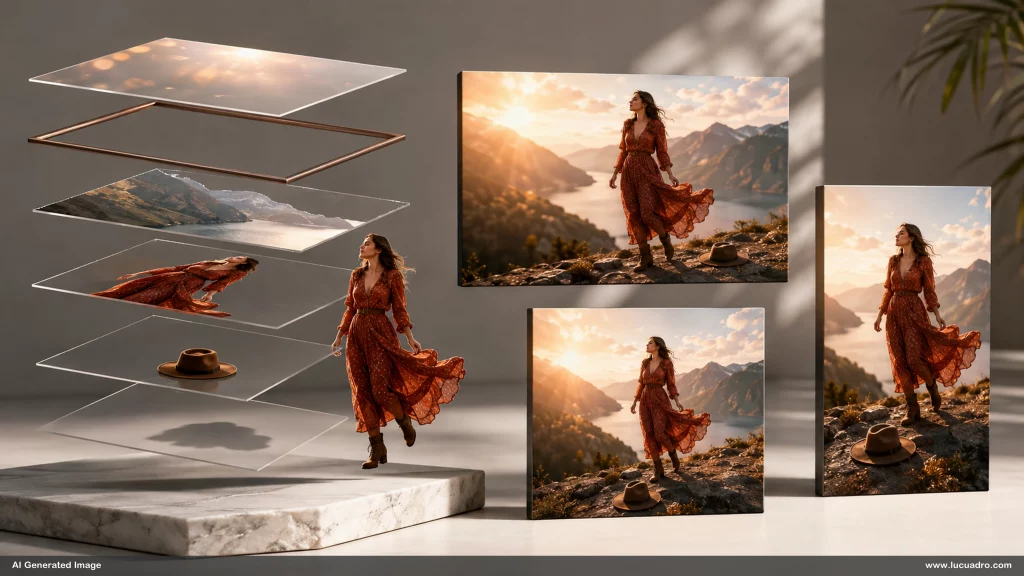
The principle is simple: preserve choices for later. When an image generator bakes subject, background, text area, lighting effect, and supporting objects into one flattened frame, the result may be finished but difficult to redirect. If the useful parts are also generated or extracted as independent assets, the same visual idea can serve multiple layouts. You are no longer choosing between using the image exactly as produced or regenerating it. You can recompose it.
Format planning matters for the same reason. A library intended for campaign reuse should contain more than one aspect ratio only when those variants serve known placements. Wide compositions need different negative space than squares. Vertical images need different subject placement than presentation backgrounds. Transparent objects may need generous padding around their edges. Generating the correct form at the start preserves image quality and reduces the amount of destructive cropping required later.
Layered reuse also changes what counts as a successful AI generation session. The best result may be a set of components rather than a single polished scene. One strong environment, several compatible subjects, a family of objects, and a few effects can produce dozens of finished combinations later. That is a larger creative return than ten finished images that cannot be separated or adapted. The value sits in the number of credible compositions the assets make possible.
You do not need every asset to be literally layered in a design file for this principle to work. The library can preserve composability by generating clean backgrounds, isolated subjects, transparent overlays, and alternate versions intended to be stacked later. What matters is that useful visual decisions are not permanently fused when they do not need to be. If a campaign later changes its headline position, product, or featured person, you should be able to change that component without rebuilding the complete scene.
Negative space deserves its own place in the library because it is one of the most reusable compositional resources. A scene with deliberate open area can accept changing copy, diagrams, product cutouts, or interface screenshots while keeping the environment consistent. Generate negative space intentionally rather than hoping a crop will create it later. The location of that space should vary across the set so the same visual world can support left aligned, right aligned, centered, vertical, and presentation based layouts.
Themed Visual Asset Sets Stop Every Campaign From Starting Over
Themed visual asset sets for niche marketing campaigns solve a different problem: continuity of subject matter. A generic collection may contain many usable files and still fail when you need a full campaign about one specific context. The missing asset is rarely another generic office image. It is the alternate angle of the same environment, the close detail that supports a secondary message, the empty frame for a headline, or the matching object that makes a new composition feel connected to the original set.
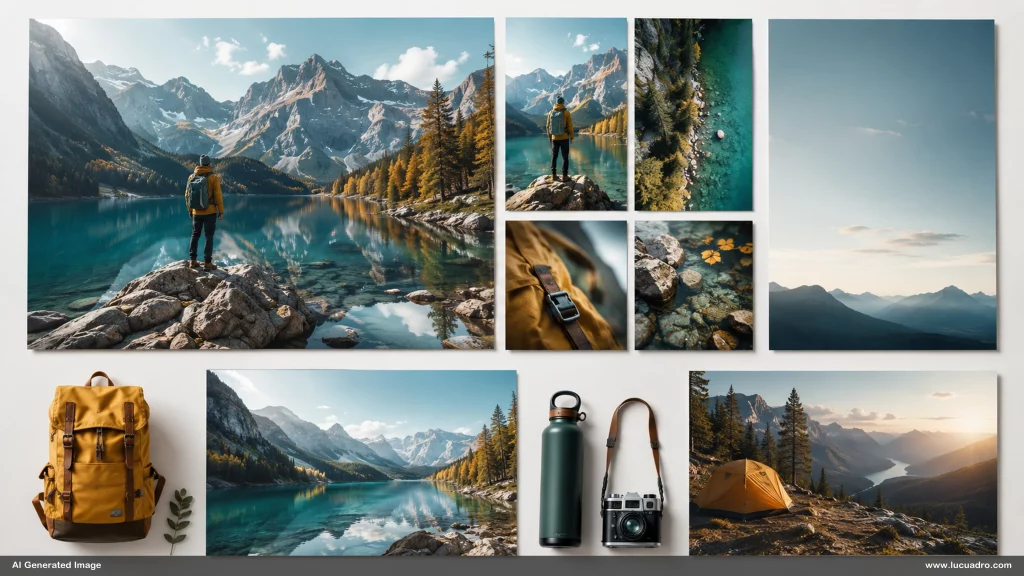
A useful theme is therefore broader than a subject label and narrower than a general category. Instead of building a folder called business, build a visual world around a particular recurring use case. That world can include environments, objects, people, details, empty compositions, and alternate perspectives. The theme gives the set coherence, while the variation gives it enough range to survive across multiple pieces of content. You can then reuse the visual world without repeating the same image.
This matters because campaigns are sequences. Viewers encounter a hero image, a follow up post, a slide, a thumbnail, a section graphic, and perhaps a later retargeting creative. If each piece starts from a disconnected visual idea, the campaign loses accumulated recognition. A themed set lets the imagery change while the world remains familiar. That makes reuse feel intentional rather than repetitive, and it gives you a deeper pool of material before the campaign begins to look recycled.
The most durable sets also leave room for expansion. Do not generate every conceivable variation at once. Establish the visual grammar, cover the recurring roles, and keep the references needed to extend the set later. When a new campaign requires a different scene, you can add it to the same family instead of opening a new folder with a new style. The library then grows by extending proven themes rather than multiplying disconnected ones.
A theme can also contain controlled degrees of specificity. Some assets should be unmistakably tied to the theme, while others should be neutral enough to bridge several campaign messages. A distinctive environment establishes identity. Supporting textures, empty surfaces, close details, and secondary objects give you flexible material for less prominent placements. This balance prevents the set from becoming either generic or excessively literal. You retain recognizable character without forcing the same focal subject into every piece.
Think of the theme as a production world with boundaries. Define what belongs inside it and what would make it feel like a different campaign. Those boundaries may involve lighting, architecture, wardrobe, object families, surface materials, or camera behavior. Once they are explicit, expansion becomes easier because you know which kinds of variation are safe. The world can grow considerably without losing coherence, which is exactly what makes a themed collection more valuable after repeated use.
Naming and Metadata Turn Image Generation Into Visual Knowledge Management
A growing image library fails if retrieval becomes harder than regeneration. This happens sooner than most creators expect. Once hundreds of files accumulate, memory stops being a reliable index. Filenames such as final3, newhero2, or image_8472 contain almost no reusable information. The result is a familiar paradox: useful assets exist, but you generate replacements because finding the originals takes too long. Naming and metadata prevent the collection from turning into visual storage without practical memory.
The filename should carry stable facts that matter during retrieval. A useful structure can include theme, role, subject, orientation, variation, and version. The exact convention matters less than consistency. Metadata can then hold information that does not belong in the filename, such as style family, dominant setting, transparency, usable negative space, source prompt, reference image, licensing note, or campaign history. The goal is to make searching faster than recreating.
This is also where visual knowledge management becomes a useful operating principle. Treat every approved asset as something that may save future production time. Keep the generation context that would allow you to reproduce or extend it. Record what the asset is good for, not merely what it depicts. A file described only as laptop desk is less useful than one identified as wide hero background with clear left side copy area. The description should support a future decision, not merely document the past.
Searchability should mirror the way you actually work. If you repeatedly think in campaign role, theme, and format, your metadata should expose those dimensions. If you often need transparent assets, make transparency directly searchable. If recurring characters matter, connect each image to the same character family. Good organization is not administrative decoration. It is the mechanism that converts past image generation into present production speed.
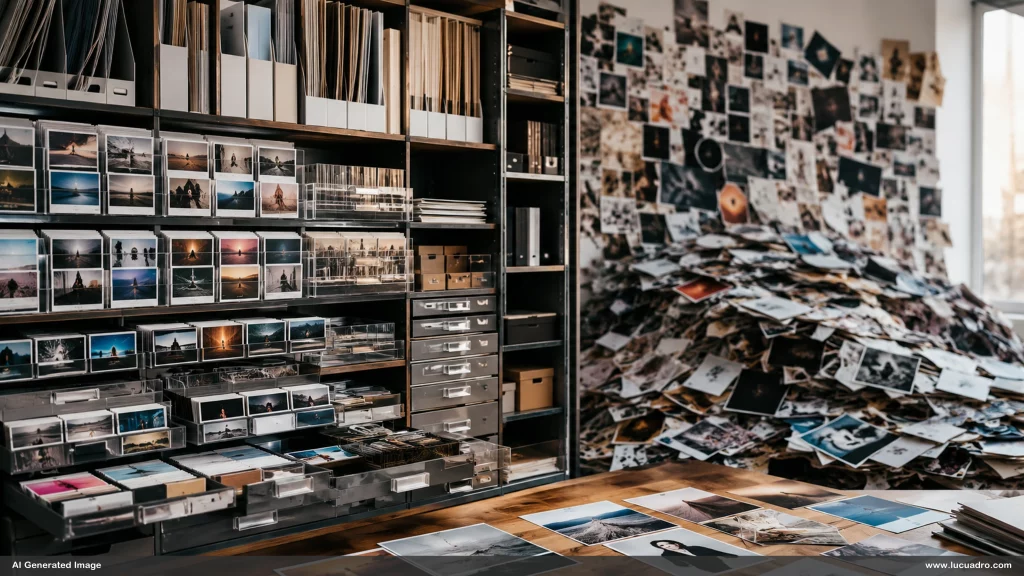
A lightweight preview system can make retrieval even faster. Contact sheets, thumbnails, or visual index pages let you scan the collection by eye before opening individual files. This matters because image search is partly semantic and partly visual. You may remember the composition you need without remembering the words used to describe it. A good index gives you both paths: searchable metadata for precise filtering and visual browsing for recognition. The faster those paths are, the more often the library actually gets reused.
Version control matters once assets begin to evolve. Keep the approved original, then distinguish meaningful derivatives such as transparent cutouts, alternate crops, retouched versions, or color adjusted variants. Do not let those derivatives overwrite the source that made them possible. A clean version history lets you return to the strongest base asset and create another derivative later. It also prevents near duplicate files from becoming impossible to distinguish once several campaigns have modified the same image.
The Best AI Image Library Gets More Valuable With Every Campaign
A reusable library becomes more valuable when every campaign contributes back to it. That requires one discipline at the end of production: separate what was campaign specific from what proved generally useful. A temporary headline treatment may not belong in the core library. A newly generated background that fits the established visual world might. A new character pose, alternate crop, or clean object can become a permanent component. Each campaign should leave the shared system slightly more capable than it found it.
This compounding effect changes the economics of creative work. The first campaign may still require substantial generation because the library is thin. The fifth campaign in the same visual territory can begin with proven materials already available. The tenth may require only a few missing pieces. You still create new work, but the ratio changes. More of the effort goes into decisions unique to the campaign and less goes into rebuilding basic visual infrastructure that already exists.
The discipline also protects against visual drift. When new assets are evaluated against an existing system, you have a reason to reject outputs that are attractive but incompatible. You can ask whether the new image expands the library or fractures it. This is especially important when new models or generation methods produce visibly different aesthetics. Technical novelty is useful only when the resulting assets can still live beside the material you intend to keep using.
Consistent characters are one area where compounding becomes especially visible. A recurring person with approved wardrobe, proportions, lighting, and expression range can support many future scenes if the character is maintained as a system. The character is no longer one image. It becomes a reusable visual component with a growing range of poses and contexts.
The final test is whether reuse makes the next campaign easier without making it look copied. A strong library gives you familiar raw material with enough variation to produce a fresh composition. It shortens the distance between idea and finished visual while preserving control over framing, hierarchy, and sequence. When that happens, the library is doing more than storing successful generations. It is absorbing creative decisions that you no longer need to solve from zero.
How to Build an AI Image Library You Can Reuse Across Campaigns ultimately means designing for future combinations. The useful unit is the reusable role, compatible visual family, searchable asset, and separable component. A consistent visual system for a brand, themed visual asset sets for niche marketing campaigns, and layered design assets you can combine into your own compositions make that reuse practical. A Lucuadro visual asset library follows this logic: build once, preserve control, and make the next composition easier to create.