

Why AI is useful for turning expert language into plain English comes down to translation between levels of familiarity. Experts compress meaning into specialized terms because those terms are efficient inside a field. The problem appears when the audience does not share the same background. AI can help unpack that compression. It can replace jargon with ordinary language, explain hidden assumptions, add missing context, and preserve the core meaning while making the material easier to understand.
Expert language is efficient for experts and expensive for everyone else
Specialized language exists for a reason. A technical term can replace an entire paragraph once everyone involved understands it. That makes communication faster inside a profession. The same efficiency becomes a barrier when the audience does not know the term, the implied background, or the distinctions packed inside it.
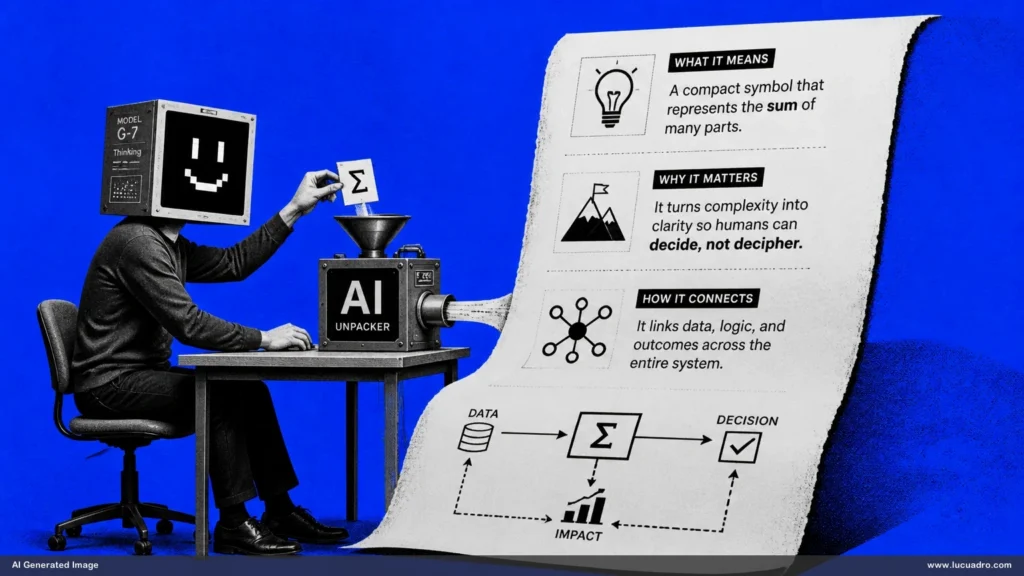
AI is useful because it can expand that compressed meaning. Instead of simply replacing one difficult word with an easier synonym, it can explain what the term refers to, why it matters, and how it connects to the surrounding idea. That makes the translation more useful than a glossary definition.
Plain English is about reducing assumptions, not reducing intelligence
Good plain-language writing does not talk down to the reader. It removes unnecessary barriers. That may mean defining a term before using it, replacing abstract nouns with concrete actions, shortening a sentence, or adding an example where the original text assumed prior knowledge. The idea itself can remain sophisticated.
AI can help identify where the original material depends on invisible expertise. You can ask which terms require explanation, which sentences contain several ideas at once, or which parts assume knowledge that a general reader may not have. The result is a clearer path into the same subject rather than a diluted version of it.

AI can preserve technical terms while making them understandable
Sometimes the technical term should stay. Removing it completely may make the explanation less useful because the reader eventually needs to recognize the real vocabulary of the field. A better approach is often to introduce the term alongside a plain explanation, then continue using it once the meaning is established.
AI is well suited to that layered approach. It can write a beginner-friendly explanation that includes the correct terminology, then add more precision in later sentences. This connects directly to how AI explains ideas at different difficulty levels. The same concept can remain accurate while the amount of assumed knowledge changes.

Examples help translate expertise into something concrete
Expert writing often relies on abstract categories because specialists already have examples in mind. A newcomer does not. Adding one concrete case can do more for comprehension than several extra sentences of definition. It gives the reader something to picture and a pattern to recognize later.
AI can generate examples matched to the audience. A technical business concept can be explained through a familiar workplace situation. A design principle can be shown through a slide, landing page, or poster. A statistical idea can be illustrated through a simple comparison. The example acts as a bridge between expert vocabulary and everyday understanding.
Different audiences need different versions of the same explanation
A plain-English version for a customer is not necessarily the same as one for an executive, trainee, or colleague from another department. Each audience starts with different knowledge and cares about different consequences. AI can help adapt the explanation without rebuilding it from scratch.
You can ask for a version focused on practical impact, another focused on risk, and another focused on how the mechanism works. The factual core can remain stable while the framing changes. This is one reason AI is useful for internal communication, training, support material, presentations, and documentation where the same information must travel across several levels of expertise.
Simplification can distort meaning if you do not protect the important distinctions
The main risk is that clearer language can become less accurate. Some technical terms carry distinctions that ordinary substitutes do not capture. A simplified explanation may remove uncertainty, exceptions, or conditions that are central to the original meaning. The result may be easier to read but conceptually wrong.
That is why constraints matter. Tell AI which terms, qualifications, and factual distinctions must remain. Ask it to flag anything that cannot be simplified safely. This connects to improving clarity without changing the core idea. Good simplification changes the expression while protecting the substance.
Plain English also makes expert material easier to verify
Dense language can hide uncertainty because readers are busy decoding the words. Once the same idea is expressed plainly, the actual claim becomes easier to inspect. You can ask whether the evidence supports it, whether an assumption is doing too much work, or whether two sentences that sounded different are actually saying the same thing.
This makes plain-language rewriting useful beyond accessibility. It can improve reasoning. By stripping away unnecessary linguistic complexity, AI can expose the structure of the argument itself. That makes it easier for both experts and non-experts to see what is being claimed and where verification is still needed.
The best translation keeps the expertise and removes the friction
Understanding why AI is useful for turning expert language into plain English helps you use it as a communication bridge rather than a simplification machine. The goal is to preserve the concept, keep necessary terminology, expose hidden assumptions, add useful examples, and reduce the effort required to follow the explanation.