
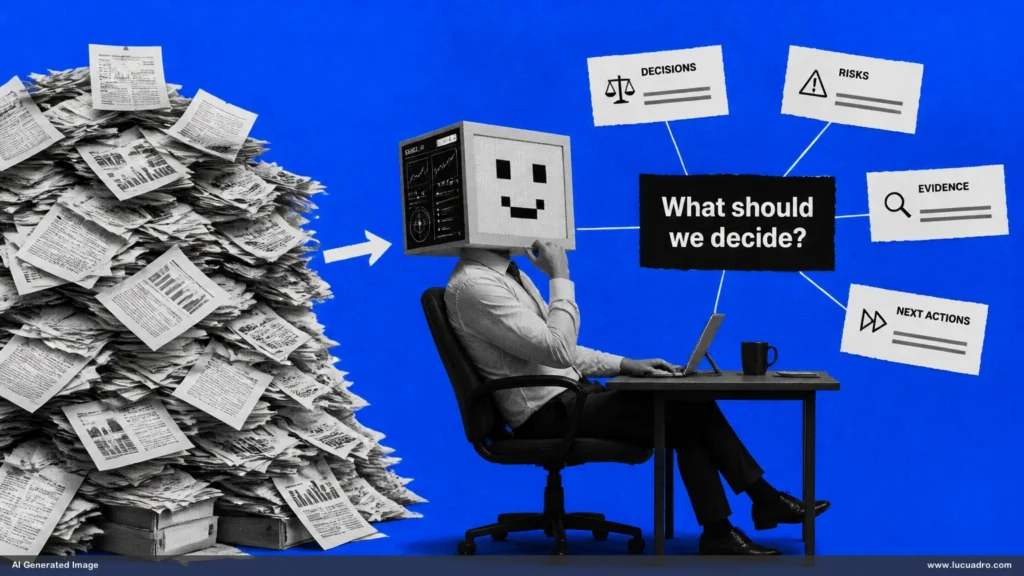
Why AI is useful for turning research into working knowledge is not mainly about finding more information. The real advantage is helping you convert scattered material into something you can actually use. Research often arrives as notes, reports, articles, quotes, findings, and disconnected observations. AI can help organize that material around decisions, questions, frameworks, and next actions so the information becomes easier to retrieve, compare, explain, and apply.
Research becomes useful when it is organized around a purpose
Collecting information is easy to mistake for understanding. You can save dozens of articles and still have no clear answer to the question you started with. The problem is usually not a lack of material. It is that the material has not been organized around a practical purpose.
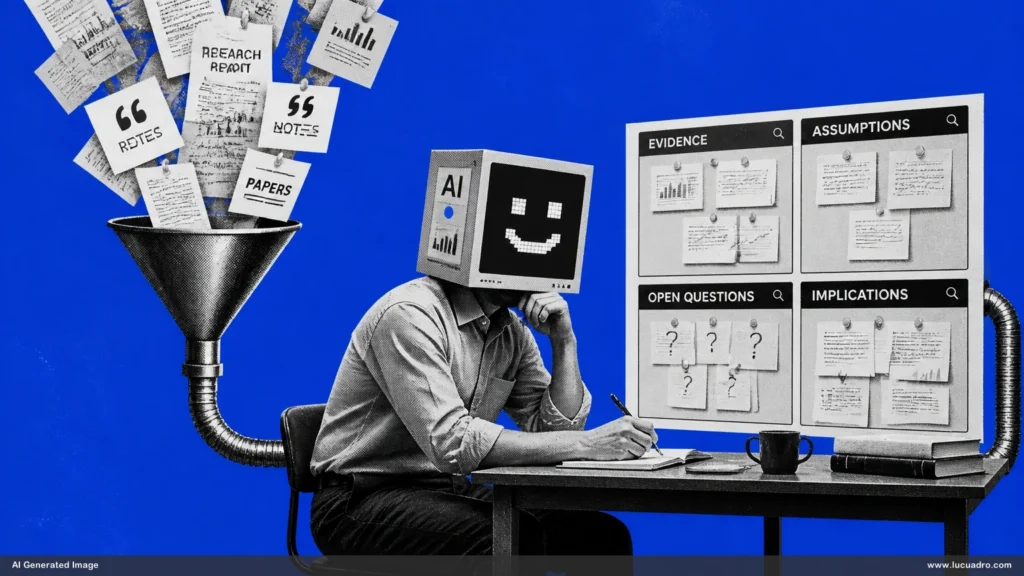
AI can help by reframing the research according to what you need to decide, build, explain, or test. Instead of summarizing everything equally, you can ask it to separate evidence, assumptions, open questions, risks, examples, and implications. That turns a pile of sources into a working structure.
AI can compress sources without losing their relationship
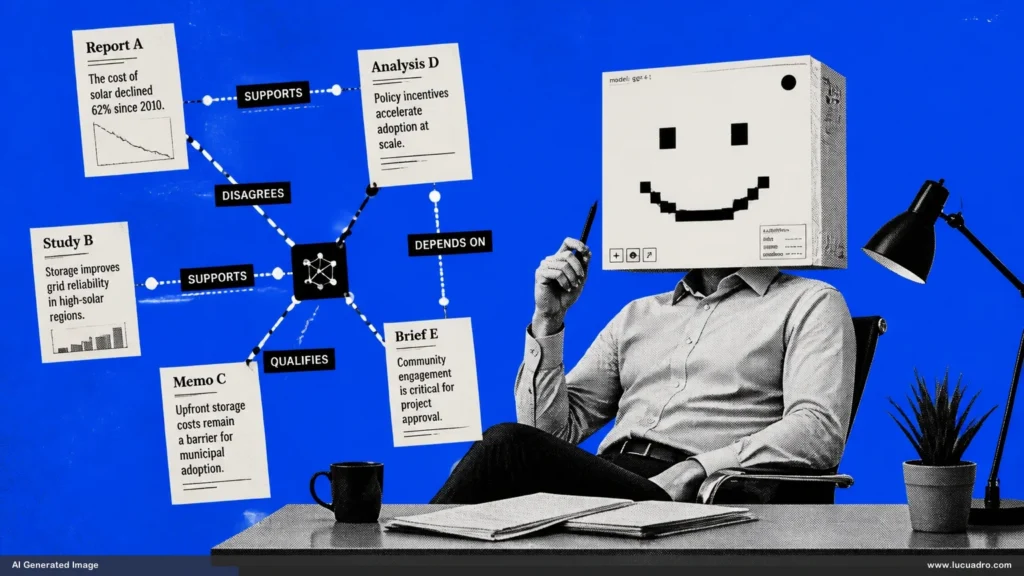
A useful research system does more than shorten documents. It preserves how the pieces relate. One source may provide evidence, another may challenge the conclusion, and a third may define an important exception. If those relationships disappear, the research becomes a set of isolated summaries.
AI can help create a connected representation by grouping sources around themes, claims, disagreements, and dependencies. This makes it easier to see where evidence converges and where uncertainty remains. The goal is not simply less information. It is a more navigable model of the information you already have.
Questions turn passive research into usable knowledge
Research becomes more operational when you can interrogate it. Instead of rereading a source from beginning to end, you can ask what it says about a specific issue, which assumptions support a conclusion, what evidence is missing, or where two sources disagree.
This connects directly to turning vague ideas into concrete questions. The better the question, the easier it is to retrieve the part of the research that matters. AI can help turn a broad topic into a sequence of narrower questions that gradually produce a more useful understanding.

AI can help convert findings into decisions and next steps
Working knowledge has consequences. It changes what you do next. A useful research synthesis should therefore go beyond describing what the sources say and identify what follows from them. Which options look stronger? What risks remain unresolved? What evidence would change the decision? What should be tested before committing?
AI can help organize those implications, especially when the decision criteria are explicit. You can ask it to connect findings to actions while keeping the supporting evidence visible. That reduces the gap between reading and doing.
Reusable structures make research easier to return to later
One of the biggest weaknesses of ordinary research is that useful insights are easy to lose. Notes are stored in one place, links in another, and conclusions in a document that becomes difficult to navigate a month later. The research was useful once, but not designed for reuse.
AI can help convert the material into durable structures such as question-and-answer references, decision memos, comparison frameworks, topic maps, evidence tables, or concise briefing notes. These forms are easier to revisit because they preserve the logic of the research rather than only the raw source material.
Comparisons become more valuable when the research is normalized
Research from different sources is often difficult to compare because each source uses its own categories, terminology, and emphasis. AI can normalize that material into a common frame. Once the same questions are asked of every source, differences become clearer.
This is closely related to comparing documents side by side. The value comes from forcing unlike material into comparable categories while preserving enough source detail to verify the conclusion.
AI is also useful for maintaining several representations of the same research at once. A detailed source map can support verification, a concise briefing can support a meeting, and a short checklist can support execution. Because each representation points back to the same evidence base, you can move between depth and speed without rebuilding the research from scratch.
Source grounding matters more as research becomes more compressed
The more research is transformed, the easier it becomes to lose track of where a claim came from. AI can create a clean synthesis that sounds coherent even when one piece is weakly supported or an important qualification was dropped. That makes traceability essential.
For serious work, keep source references attached to important claims. Ask the model to distinguish direct evidence from inference, note disagreements rather than smoothing them away, and mark missing information instead of filling it. Working knowledge should be easier to use without becoming harder to audit.
The strongest outcome is a research system you can think with
Understanding why AI is useful for turning research into working knowledge helps shift the goal from collecting information to building a usable mental and operational model. AI can organize sources, connect claims, generate questions, surface disagreements, and translate findings into next steps. That is more valuable than another folder full of unread material.