
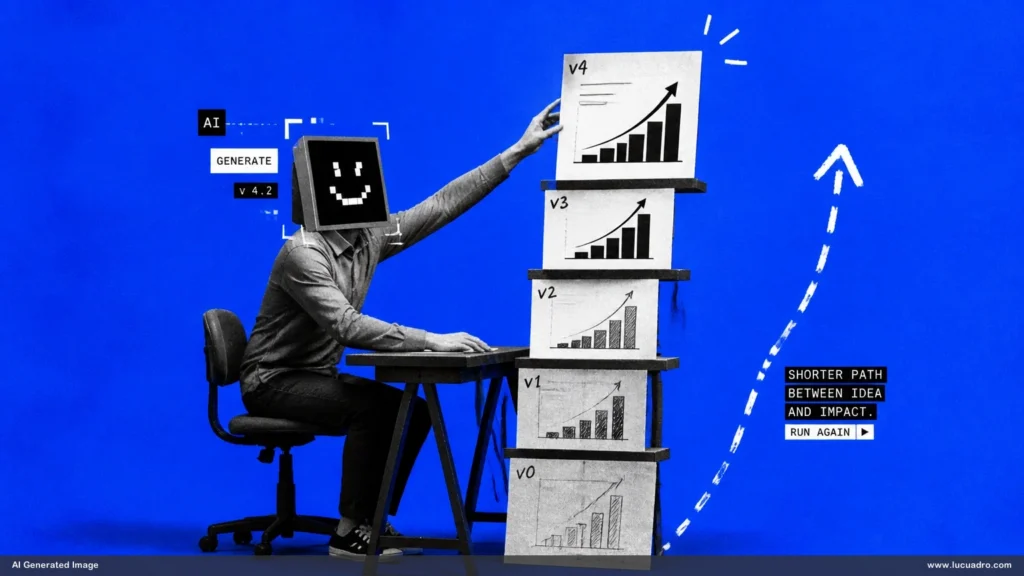
Why AI makes creative iteration much faster has less to do with one perfect generation and more to do with how quickly you can move from one version to the next. Creative work often improves through repeated adjustment: change the framing, tighten the message, simplify the layout, test another tone, or explore a different visual treatment. AI reduces the production cost of those passes, which means you can learn from more versions before settling on the final direction.
Iteration is where many creative ideas actually become good
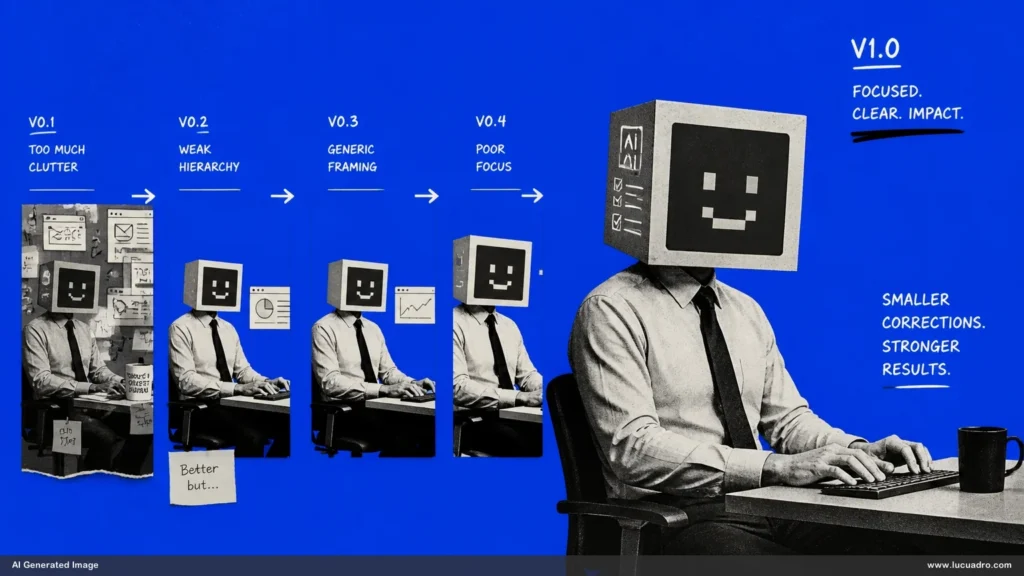
First versions are often incomplete. The core idea may be right while the execution is too broad, too busy, too generic, or poorly matched to the audience. Creative quality usually emerges through a sequence of small corrections rather than one dramatic breakthrough.
AI makes those corrections cheaper to explore. Instead of rebuilding a draft manually every time, you can request a tighter version, a different structure, an alternate composition, or a new emphasis. That shortens the distance between noticing a problem and seeing a possible fix.
Faster feedback loops create more opportunities to learn
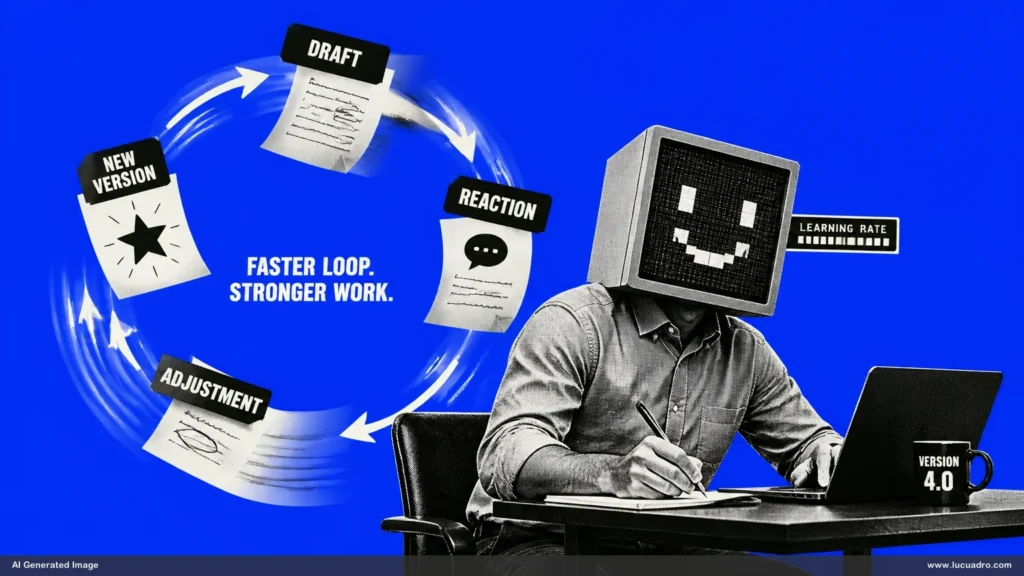
Every iteration produces information. You discover whether a shorter headline is clearer, whether a different crop improves focus, whether a stronger contrast changes the hierarchy, or whether removing an element makes the composition easier to understand. The value is not only the new version. It is what the new version teaches you about the problem.
AI accelerates that learning cycle because the next test can often be produced immediately. When the cost of a revision falls, you can examine more hypotheses instead of committing early to the first acceptable solution.
Controlled changes are more useful than random regeneration
Iteration works best when you know what changed. Asking for a completely new version may produce something interesting, but it makes cause and effect harder to judge. A better approach is to vary one dimension while holding the others reasonably stable.
You might preserve the message and change only the visual hierarchy. Keep the composition and test three different moods. Hold the reference image constant while changing the background treatment. This connects to creative variation rather than creative replacement. AI becomes more useful when it explores a defined space rather than restarting the creative problem every time.
AI lowers the cost of exploring weak directions early
Traditional production can make people reluctant to test uncertain ideas because each version consumes time. That encourages premature commitment. A direction may survive simply because too much effort has already been invested in it.
When AI can produce an early draft quickly, weaker directions can be tested before they become expensive. You can reject a visual concept, message angle, or structure after a rough pass instead of after hours of polishing. That is valuable because iteration is partly about discovering what not to pursue.
Speed matters most when the evaluation standard stays high
More versions do not automatically create better work. Fast iteration can also produce noise, especially when every output is accepted because another one is easy to generate. The bottleneck shifts from production to judgment.
You need criteria for deciding whether a change actually improved the work. Clarity, hierarchy, distinctiveness, audience fit, consistency, and practical usability are more useful standards than novelty alone. Faster iteration is valuable when each pass is tested against a stable objective.
References make repeated iteration more coherent
A reference provides continuity across versions. Without one, every generation may drift in composition, style, character, lighting, or visual identity. That makes it difficult to tell whether the intended change caused the improvement or whether the entire output simply changed.
Using reference material narrows the creative space and gives each iteration a stable base. This is especially important when you need multiple outputs to feel like parts of the same system rather than isolated experiments. Consistency makes iteration cumulative instead of chaotic.
Iteration can happen at several levels of the creative process
AI can accelerate more than final execution. It can help iterate on the brief, concept, structure, message, visual direction, examples, and presentation of the idea. That means problems can be corrected earlier, before they become embedded in expensive production.
This is related to generating alternatives with AI, but iteration adds a feedback loop. You are not merely creating options. You are using the result of one pass to decide what the next pass should change.
There is also a practical benefit for collaboration. A team can react to something concrete much earlier in the process. Instead of debating an abstract direction for too long, you can generate a rough execution, gather feedback, and refine the brief based on what people actually see. That reduces ambiguity and makes creative discussion more specific.
Early visual or written versions can also expose conflicts that were hidden in the brief. Two stakeholders may think they agree until they respond differently to the same draft. Faster iteration surfaces those disagreements sooner, when changing direction is still relatively inexpensive.
The real advantage is more learning per unit of production effort
Understanding why AI makes creative iteration much faster helps explain why generative tools can improve creative workflows even when the final judgment remains human. The model reduces the cost of producing the next test. You gain more opportunities to compare, reject, refine, and improve before committing to the final execution.